Check out the 1970s New York gang documentary, 80 Blocks from Tiffany’s.
Check out the 1970s New York gang documentary, 80 Blocks from Tiffany’s.

Posted in Uncategorized | Leave a Comment »
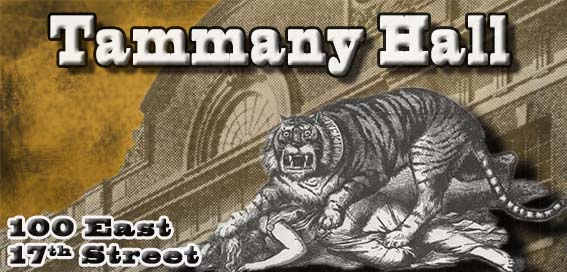
Location: 100 East 17th Street
Status: Landmarked
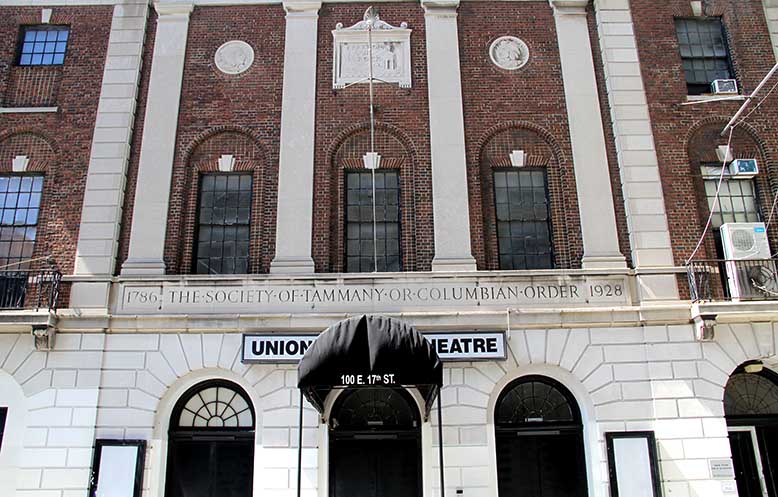
It was the last wigwam, the tiger’s lair where Tammany Hall reached it’s zenith before fading into historical footnote. Funded by a prohibition-era bankroll, the red brick, Neo Georgian structure located at 100 East 17th Street on the North East Corner of Union Square, represents the last true home of New York’s greatest political machine.
Constructed at cost of $350,000, the building was dedicated on July 4, 1929, by Presidential Candidate Alfred E. Smith, a notorious “wet” who vowed to end prohibition if elected, and his archrival, Franklin Delano Roosevelt, an upstate politician who would do more to destroy Tammany Hall than anyone else.

Tammany Hall was located at 100 East 17th Street.
Whitewashing Corruption
For an added touch to whitewash the corruption, the architects decked the building out in patriotic splendor, choosing bricks modeled from Thomas Jefferson’s home at Monticello.

This balcony overlooking Union Square served as Tammany Hall’s bully pulpit, allowing politicians to address the masses below.
On the 17th Street entrance to the Hall, columns inspired by Federal Hall, the site of George Washington’s presidential oath, adorned the second and third floors.
Nearby, friezes of Christopher Columbus, a Revolutionary War era liberty cap and Chief Tammany, the organization’s namesake, ornamented the exterior of the building.
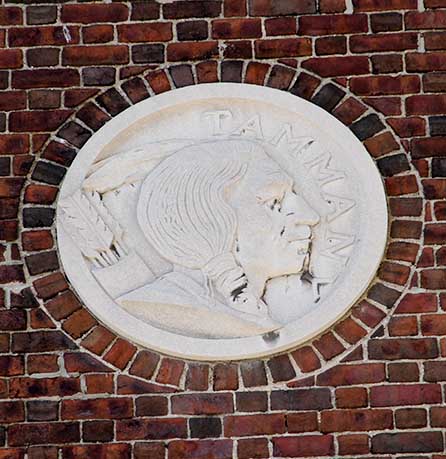
Chief Tammany, namesake of Tammany Hall.
Tammany’s Bully Pulpit
The focal point of the entire wigwam was a balcony, which served a pulpit for Tammany bigwigs such as: Mayor Jimmy Walker, presidential candidate Alfred E. Smith, and Senator Robert Wagner to speechify to masses gathered around Union Square. But little did the sachams know, Tammany Hall had nowhere to go but down.
Tipping the Paradigm
For over 100 years, Tammany ward heelers incubated organized crime in New York City, fostering and organizing a network of gangs whom they schooled in mayhem and rolled out on Election Day.
Sent to smash ballot boxes in Republican neighborhoods and repeat vote in Democratic strongholds, Tammany awarded the crooks perpetual get out of jail free cards for their work.
Tammany politicians looted the city and taxed vice, making themselves millionaires in the process of redistributing this wealth to the city’s most marginalized inhabitants.The Hall was known for handing out ice in the summer, coal in the winter and turkeys at Thanksgiving in a time before social security.
Ultimately, prohibition turned the paradigm on its head. Bootleggers, gangsters and gunmen made multi-millions of dollars overnight and paid for their political protection, rather than earning it with their fists at the polls.
The rain of money turned into a deluge, and Tammany became minions of the mob. By the 1930s, the Hall was firmly in the hands of the National Crime Syndicate with Lucky Luciano, Dutch Schultz and Frank Costello puling the strings.
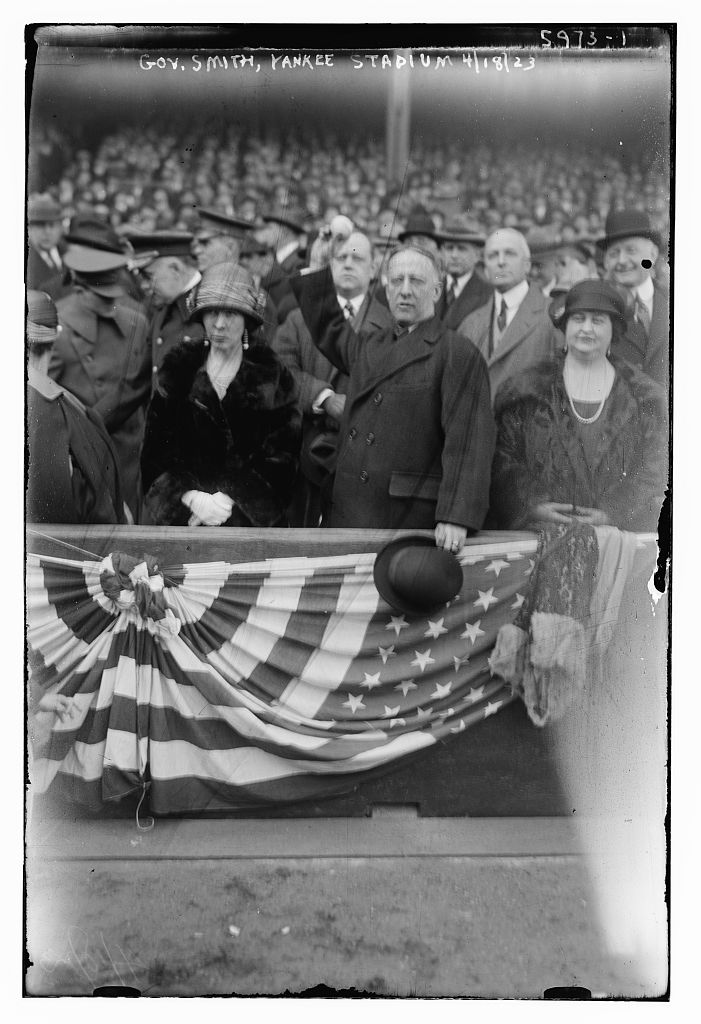
Tammany Sachem, Alfred E. Smith, dedicated the building alongside his political rival, Franklin Delano Roosevelt, a man who did more to destroy Tammany than anyone else.
Under intense pressure from FDR and Fiorello La Guardia, the hall vacated the building in 1943, selling it to a labor union, marking the beginning of an irreversible decline. On the occasion, Mayor La Guardia remarked:
“You know, I wouldn’t change the name of the building [Tammany Hall]… I would keep it as a permanent monument to the change that came for the City of New York when a mighty, ruthless organization left the building to an organization of the people.”—Fiorello La Guardia

Posted in Fiorello La Guardia, Frank Costello, Lucky Luciano, Tammany Hall | Tagged 100 East 17th Street, Alfred E. Smith, Chief Tammany, Dutch Schultz, FDR, Federal Hall, Fiorello La Guardia, Frank Costello, Franklin Delano Roosevelt, Lucky Luciano, Mayor Jimmy Walker, National Crime Syndicate, Robert Wagner, Senator Robert Wagner, Tammany Hall, Wigwam | 1 Comment »
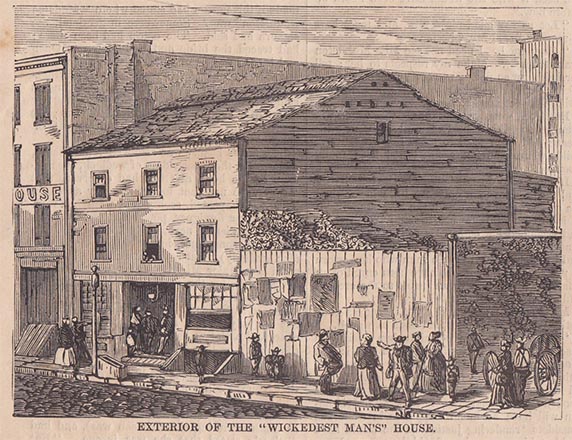
The Wickedest Man’s Dance Hall and bordello at 304 Water Street circa 1868
Location: 304 Water Street
Status: Demolished
Priests, police, and just about everybody in Manhattan called John Van Allen the Wickedest Man in New York, and he reveled in it. A born self-promoter, if Allen had been alive today he probably would have had a reality television series.
In a twenty-year life of crime, Allen set the tabloids aflame with his wacky antics even attracting the attention of Mark Twain who described the forty-five year old dancehall owner and pimp as,
“A tall, plain, boney, fellow, with a good-natured look in his eye, a Water Street air all about him, and a touch of Irish in his face.”—Mark Twain
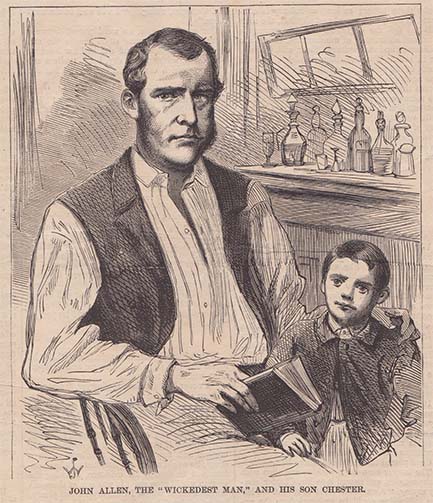
John Allen the Wickedest Man in New York and his son, Chester, a lad “hell on reading, writing, praying and fighting.”
House of Rum and Prostitution
Strangely enough, Allen and his criminal brothers Westley (Wess), Theodore (The.), Martin and Jesse were the sons of a wealthy Presbyterian minister. John amassed over 113 arrests for running disorderly houses across the city, but his most infamous den was a dancehall located at 304 Water Street.

Known for dancing prostitutes and cheap rum, Allen’s Dancehall would earn him the title: Wickedest Man in New York
Demolished to make way for the Brooklyn Bridge in 1870, his three story bilious green, bordello offered several dance floors, an orchestra pit and booths for sex. According to Herbert Asbury’s Gangs of New York, Allen staffed his club with twenty prostitutes dressed in,
“…low black bodices of satin, scarlet skirts and stockings, and red topped boots with bells affixed to the ankles.”

The Wickedest Man In New York holds court in his bar.
A Breathing Hole of Hell
According to Edward Winslow Martin’s Secrets of the Great City published in 1868, Allen’s dancehall was:
“…a breathing hole of hell—a trap door of the bottomless pit… where lousy loafers lurk..”
Allen lived above his bar with his wife, seven daughters and son, Chester, a lad who according to his dad was “hell on reading, writing, praying and fighting.”
In reality, Allen probably wasn’t the wickedest man on Water Street by a long shot (the title rightly belonged to Tommy Hadden), but after his ceaseless campaigning for the title, the moniker stuck when the Allen transformed his whorehouse into New York City’s wackiest religious revival.


Posted in Corlear's Hook, Gangs of New York, Nightlife, South Street Seaport, Water Street Revival | Tagged 4th Ward, Brooklyn Bridge, Corlear's Hook, Gangs of New York, Herbert Asbury, John Allen. 304 Water Street, Saloon, South Street Seaport, The. Allen, Theodore Allen, Wess Allen, Westley Allen, Wickedest Man in New York | Leave a Comment »

Location: 6-8 West 28th Street
Status: Standing
He was like John Dillinger, Al Capone and Jesse James rolled up into a 19th century bundle. Generous, refined, wealthy and deadly, Tomas “Shang” Draper ran one of the most opulent casinos in Manhattan here at 6 West 28th Street in the heart of Satan’s Circus.
King of Safecrackers
The Italianate brownstone casino represented the pinnacle of Shang Draper’s life of crime. Former king of the bank robbers and safecracker extraordinaire, Shang was one of the best petermen in the country, blowing bank vaults from New York to Minnesota.

Shang Draper’s casino was located at 6 West 28th Street
Fencing with Marm
Together with society figure and architect, George Leonidas Leslie, alias Western George, Shang and Leslie plundered millions, heisting the Waterford Bank in 1872, the North Hampton Bank in 1876, and the Manhattan Savings Institution in 1878. The gang specialized in looting securities, which they fenced through Fredericka “Marm” Mandelbaum.
A Taste for the Finer Things
It seemed that Shang got a taste for the finer things from Leslie, whom he eventually shot and dumped in the wilds of the Bronx. With his bank robbing fortune, Draper headed for the Tenderloin district, a place where the glitterati of Manhattan’s Gilded Age went to drink, whore, smoke opium and gamble in style.

Standing six feet tall in his silk stockings, Tomas Shang Draper was a giant by 1800s standards, and he had a personality to match.
With the backing of lottery king, Al Adams, Shang settled at 6 West 28th Street, just off of fashionable 5th Avenue. To attract wealthy patrons from nearby hotels and Madison Square Garden, Shang remolded the entire building.
Shang’s Casino
He threw up onyx pillars on the first floor. Crimson silk curtains covered the windows. Oil paintings valued at $100,000 lined the walls. The buffet was all you could eat. The plates were china and the goblets were cut glass.
The roulette wheel spun for no less than $25 a twirl, and guests, who included politicians, prizefighters, millionaires and vaudevillians, could expect to find high stakes poker, faro and chuck-a-luck.
According to Automats, Taxi Dances and Vaudeville author, David Freeland:
“Future governor [and presidential candidate] Al Smith was once reputed to have stayed at the faro tables for fifty-two hours straight.”
Underworld Fortress
Big money meant big security. To guard against raiding cops and stickup gangs alike, Shang installed a battering-ram proof door equipped with a mechanical cross bolt that dropped into the doorjamb. Behind the door, a steel cage provided secondary defenses, while a sliding steel grate protected every window. Simply put: it was the coolest fortress in town.

One of the most opulent casinos in Manhattan, Shang Draper turned this brownstone into a fortress with steel grates and a battering-ram proof door.
Coppers!
But the Parkhurst Society wanted the club closed. On October 14, 1902 police officers raided the casino, but the heavily fortified club took hours to breach, giving Shang’s customers enough time to scramble out of a secret back staircase on the building next door. The police eventually recovered hundreds of thousands of dollars in Shang’s safe. After the raid Draper retired to Hot Springs Arkansans.

Posted in Broadway, Casinos, Gangs of New York, Lifestyles of the Rich and Infamous, Tenderloin / Satan’s Circus | Tagged 6 West 28th Street, Al Smith, Casino, Chuck-a-luck, Faro, Fredericka “Marm” Mandelbaum, George Leonidas Leslie, Manhattan Savings Institution, Manhattan Savings Institution Robbery, Marm Mandelbaum, Satan’s Circus, Shang Draper, Thomas Shang Draper | Leave a Comment »
Project Underworld: The Incredible alliance between the Navy and the Mafia during the Second World War.
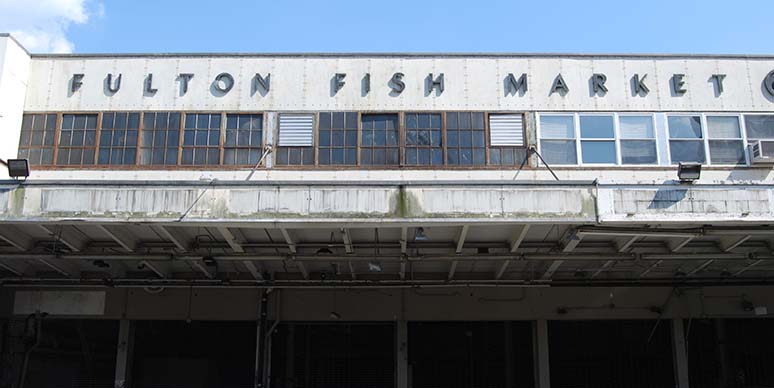
Location: Fulton Fish Market and the Meyer Hotel, 119 South Street
Status: Landmarked
Closed lipped and insular, the longshoremen of the Fulton Fish Market proved impossible to infiltrate, but the Office of Naval Intelligence (ONI) knew there was no other option. By 1942, Nazi submarines pushed the Allies to the breaking point, sinking 650,000 tons of cargo a month. Observers spotted U-boat wolf packs roving up and down the cost of Long Island. Then on February 9, the troop transport Normandie spontaneously combusted on the West Side of Manhattan.
Nazi Spies in New York
To ONI, it was obvious. Nazi agents had infiltrated the Port of New York, and only the mob had the power to hunt them down. Here at the Fulton Fish Market, the United States Navy orchestrated one of the most unusual alliances of WWII that remained a secret until 1977, when author Rodney Campbell uncovered the classified Herland’s Investigative Report, a 101-page summary of the Navy’s involvement in Operation UNDERWORLD.
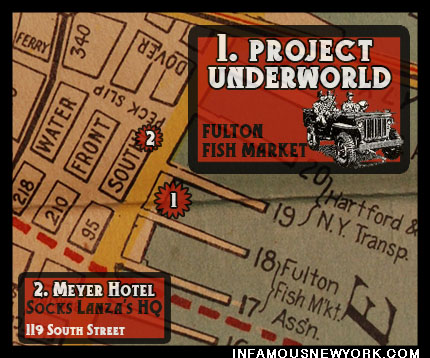
Tsar of the Fish Market
The task of penetrating the Fish Market fell to Commander Charles Radcliffe Haffenden, the swashbuckling leader of ONI’s investigative unit. With the help of the head of the New York Rackets Bureau, Murray Gurfien, Haffenden contacted the fishy tsar of the Fulton Fish Market, Joseph “Socks” Lanza, a hulking 250 lb mafia bulldozer in the Luciano Crime Family whose resume included arrests for burglary, extortion and homicide( https://infamousnewyork.com/2013/08/26/socks-lanza-the-seafood-king-strikes-again/ ).
Up in The Old Hotel
From his headquarters in the Meyer Hotel above the infamous Longshoreman bar, the Paris Café, Socks’ clammy grip on the United Seafood Workers Union stretched from Florida to Maine.
The NY DA’s office arranged a secret meeting with Socks where Gurfein pleaded:
“Many of our ships are being sunk along the Atlantic coast. We suspect German U-boats are being refueled and getting fresh supplies off our coast…You can find out how and where the submarines are being refueled.”
Socks jumped at the chance to aid the Navy, but the DA’s office wiretapped Lanza’s phones at the Meyer hotel to ensure his loyalty. Their bugs would record conversations detailing Navy inspired mayhem that included assaults, break-ins, and possible murders.
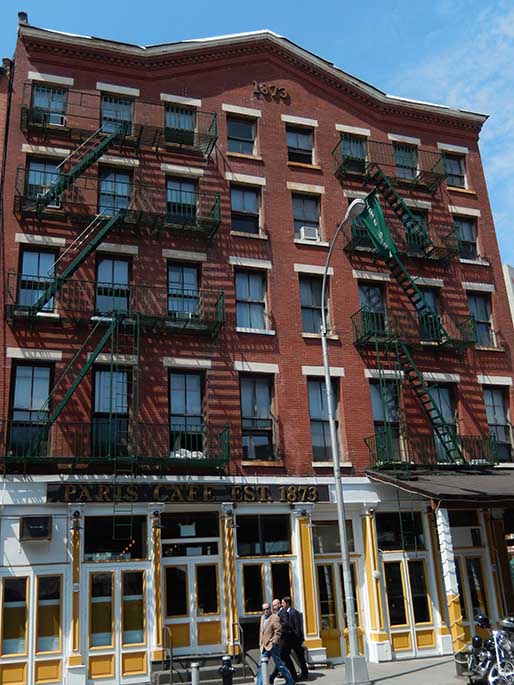
Socks Lanza managed the mob’s end of Project UNDERWORLD from his office at the Meyer Hotel on South Street.
Agent Lanza
The next morning Lanza called his long time associate Benjamin Espy, a former bootlegger who served time in Lewisburg Penitentiary. Together Lanza and Espy demanded that ship suppliers report unusual purchases of fuel to them. Next, the two gangsters moved onto the fishing vessels and set up a network of fishermen to keep an eye out for submarines. The fish racket boss’ success startled Haffenden. Sensing the Mafia’s influential grip, the commander requested union books to place agents on long-range fishing vessels. Socks responded by providing his personal books used for no show payoff jobs, and Haffenden’s agents sailed aboard mackerel fleets bound for Maine, Florida and Newfoundland under the protective wing of the Mafia.

Socks Lanza, tsar of the Fulton Fish Market.
Branching Out
Commander Haffenden wanted more. He wanted access to the West Side piers controlled by the Irish Mob’s Joseph Ryan and his enforcer Johnny Cockeye Dunn, as well as the Brooklyn waterfront, controlled by Albert Anastasia. Joe Socks balked at the prospects of facing Anastasia’s explosive temper and legendary trigger finger. Furthermore, Lanza lacked the influence to cross the ethnic divide into Irish controlled Hell’s Kitchen.
According to Socks Lanza, there was only one man capable of:
“Snapping the whip in the entire underworld.”
That man was New York’s imprisoned emperor of vice, Lucky Luciano.

Posted in Five Families, Fulton Fish Market, Irish Mob, Lucky Luciano, Mafia, South Street Seaport | Tagged 119 South Street, Benjamin Espy, Charles Haffenden, Cockeye Dunn, Commander Haffenden, Fulton Fish Market, Irish Mob, Joe Socks, Joseph Lanza, Joseph Ryan, Luciano Crime Family, Lucky Luciano, Mafia, Meyer Hotel, Mob, Murry Gurfein, Nazis, Normandie, Office of Naval Intelligence, ONI, Paris Café, Second World War, Socks Lanza, Submarines, U-Boats, United Seafood Workers Union, WWII | 2 Comments »
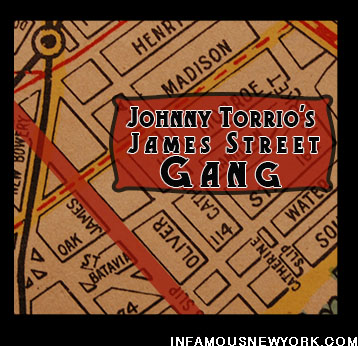
The territory of Johnny Torrio’s James Street Gang
Location: James Street
Before the St. Valentine’s Day Massacre and Prohibition put him on the map, Al Capone received his bachelor’s degree in gangsternomics courtesy of Johnny “The Fox” Torrio, a future mafia chieftan who got his start as the leader of the James Street Gang.
A dormouse of a man with button eyes and a nose like a thimble, Torrio could only be described as one of the finest criminal mastermind’s of the 20th century, and it all started on James Street, a tiny sliver of a street that is one of the last remaining vestiges of the old Corlear’s Hook neighborhood.
Life in crime came early for Torrio. As a boy he worked in his stepfather’s illegal moonshine den at 86 James Street. In 1904, the urchin started promoting boxing matches, where he met the bantamweight fighter and gangland kingpin, Paul Kelly. Kelly, a suave racketeer whose real name was Paolo Antonini Vacarelli, captained the Five Points Gang, a mob that ran Little Italy and fixed elections for Tammany Hall.
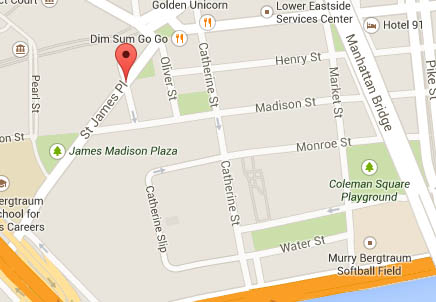
Much of James Street was demolished during the 1940s.
Kelly took an immediate liking to Torrio, teaching the young gangster how to dress, speak, and steal. In return for his mentorship, Torrio founded a Five Points auxiliary called the James Street Boys to aid Kelly and the Yakey Yakes during the Eastman Wars.
From there “The Fox,” moved on the Irish controlled Brooklyn Navy Yard with the help Frankie Yale and a teenaged enforcer named Al Capone, whom Torrio introduced to the Manhattan underworld through his James Street connections. Torrio gave up his mini- New York empire when Chicago’s prostitution overlord, Big Jim Colosimo, requested Torrio’s aid to protect his Windy City whorehouses. “The Fox” left New York but always remembered his roots by importing James Streeter gunmen like Roxie Vanella (https://infamousnewyork.com/2013/09/27/the-mayor-of-james-street-robert-roxie-vanella/ ) and Frankie Yale to do his dirty work. Torrio called for Capone in 1921, and the pair went on to make gangland history.

Johnny Torrio

Posted in Al Capone, Corlear's Hook, Five Families, Gangs of New York, Johnny Torrio, Mafia, Paul Kelly, South Street Seaport | Tagged Al Capone, Big Jim Colosimo, Frankie Yale, James Street, James Street Gang, Johnny Torrio, Paolo Antonini Vacarelli, Paul Kelly, Yakey Yake | 1 Comment »


15 Pell Street
This non-descript building is the current headquarters of the over 100-year-old Hip Sing tong. Founded in San Francisco during the gold rush, the Hip Sings were brought to New York City by Laing Yue in the 1890s. Mock Duck (see 15) would eventually become their most infamous leader. The Hip Sings still control much of the vice in Chinatown through their association with gangs like the Flying Dragons. http://en.wikipedia.org/wiki/Flying_Dragons
5-7 Doyers Street
On August 7, 1905, Hip Sing headman, Mock Duck, ordered several of his boo how doy, or hitmen to go on a rampage. Led by his top gunman Sing “The Scientific Killer” Dock, they entered the Chinese theater and opened fire using exploding firecrackers to cover their gunshots. 4 On Leongs were killed.
Click to read a more detailed story on the Chinese Theater Massacre. https://infamousnewyork.com/2013/09/01/the-chinese-theater-massacre/
5 Doyers Street
Back around the turn-of-the-century, Chinatown was infested with a warren of tunnels that were used for smuggling, gambling, and quick getaways from the cops. 5 Doyers Street is the last accessible vestige of this tunnel network known today as the Wing Fat Shopping arcade. Oh, and by the way, they don’t like guests.
13 Pell Street
Wah Kee, one of Chinatown’s first residents, set up shop here some time around 1868. On the ground floor he sold Chinese curios and exotic foods, but upstairs was where the real action was. Along with a fan-tan gambling parlor, Kee ran Chinatown’s first opium den, which was completely legal at the time.
7-9 Mott
Following the Chinese Theater Massacre (see 2), Chinatown was in lockdown. The bombings, shootings and hatchet murders had completely disrupted vice in the district, and Tammany Hall’s Big Tom Foley stepped in to end the bloodshed. With the help of General Sessions Judge Warren W. Foster, Foley brokered a peace, making Mott Street On Leong territory, Mott Street Hip Sing territory and Doyers Street neutral ground.
To celebrate the truce, the rival gangs headed to the swankest joint in all of turn-of-the-century Chinatown, The Port Arthur Restaurant, and proceeded to get hammered. Tom Lee (see 13) supposedly guzzled 107 mugs of rice wine at the shindig.
13 Doyers Street
In business since 1920, the Nom Wah Tea Parlor is the closest you’ll get to authentic early 20th century dim sum. The restaurant has nothing to do with crime or tongs, but if you’re touring the Bloody Angle (see 8) be sure to give the traditional eggrolls a try.
12 Pell Street
One of Big Tom Foley’s chief election captains, Mike Salter ran a gang that included Jack Sirocco and Chick Tricker from this ragtime saloon named The Pelham Café. Irving Berlin worked here as a singing waiter, and under the threat of a beating, Salter forced him to write his first song, launching Berlin’s music-making career. Upstairs, Salter ran a multiple story opium den managed by Big Mike Abrams.
Click to read more about Mike Salter’s Pelham Café https://infamousnewyork.com/2013/08/12/mike-salters-pelham-cafe-birthplace-of-irving-berlin/
Sandwiched between Pell and Mott, Doyers Street has one of the most crooked histories in town. Neutral ground for the feuding On Leong and Hip Sing Tongs, Doyers has been the site of more than one full-scale kung-fu rumble, earning it the nickname, “The Bloody Angle.”
83-89 Mott Street
This awe-inspiring pagoda towering over Chinatown is the current headquarters of the hundred-year-old On Leong Tong. Led by Tom “The Mayor of Chinatown” Lee (see 13), the tong still presides over much of the vice in Chinatown today trough the use of gangs like the Ghost Shadows. http://en.wikipedia.org/wiki/Ghost_Shadows
17 Mott
In 1882, the United States passed the Chinese Exclusion Act, a law deliberately designed to artificially limit the number of Chinese women in America. By 1890, less than 3.6 percent of all Chinese residents of America were female, a drastic sex imbalance that would lead to many Tong wars, such as the case of Bow Kum, a Chinese slave girl purchased at auction in San Francisco for $3,000 by Hip Sing member Low Hee Tong.
After Christian missionaries freed Bow Kum from slavery, she traveled to New York and married Tchin Len, a farmer who also happened to be a member of the On Leongs. When Low Hee caught up with his expensive ex-wife, he demanded her back, the On Leongs refused, and the tongs went to war. On August 15, 1909, a Hip Sing hatchetman slipped into Len’s apartment at 15 Mott Street and hacked Bow Kum to death, instantly kicking off one the bloodiest tong struggles.
19 Elizabeth Street
Opened in 1882, the 5th Precinct has policed Chinatown for more than 100 years, raiding opium dens, busting up fan-tan games, and bringing justice to the tongs. Designed by NYPD sergeant and architect Nathaniel Bush, the precinct contained 12 cells for women and 16 cells for men.
10 Chatham Square
During the Bow Kum War, the Hip Sing Tong posted a public death threat against the On Leong comedian Ah Hoon. Apparently Hoon’s act of skewing the Hip Sings had pissed off the gangsters for the last time. On December 30, 1909, two patrolmen from the 5th precinct protected Hoon during his act at the Chinese Theater and escorted him though the Chinatown tunnels to his home.
The cops left him with a warning not to leave his room before they left him for the night, but a thirsty Hoon ignored their warning and opened his door for a glass of water. Hip Sing gunmen waiting in the shadows opened fire killing him instantly.
18 Mott
People called him the Mayor of Chinatown and for good reason. Tom Lee was the headman of the On Leong Tong, controlling much of the gambling, prostitution, and opium in Chinatown. His power was so great that Tammany Hall politician Big Tom Foley made him a city sheriff. He lived here at 18 Mott Street for much of his life.
7 Chatham Square
Built in 1920, this condominium’s lobby is the exit to the Chinatown tunnels. They really, really, do not like visitors.
23 Mott Street
One of the most vicious gunmen in Chinatown, Mock Duck was a gangster known for going about the streets armed with two revolvers, a hatchet, and a suit of chain-mail armor. He was tried three times for murdering a tailor here, but he was never convicted.
96-98 Mott Street and 9 Elizabeth Street
Demolished
The Big Flat started with the greatest of intentions. It was supposed to be a model for the future housing of the poor. Built as the first model tenement, the building was eventually devoured by the people it hoped to save, becoming one gigantic opium den. On December 8, 1884, detectives from the 5th Precinct raided the building. Fifteen people were arrested including Tom Lee’s (see 13) nephew.
If you think I’m missing a good map point that I can include, let me know!

Posted in Chinatown, Tong Wars | Tagged Ah Hoon, Big Mike Abrams, Bow Kum, Chick Tricker, Chinatown Tunnels, Chinese Theater, Fan Tan, Gangs of Chinatown, Hip SIng, Hip Sing Tong, Irving Berlin, Mock Duck, Nam Wah Tea Parlor, New York Opium Den, Nigger Mike Salter, On Leong, On Leong Tong, Opium, Sing Dock, The Bloody Angle, Tom Lee, Tong War, Wah Kee, Wing Fat Mansion | 4 Comments »

Frank Costello Lived Here at the Majestic Apartments.
Location: 115 Central Park West, The Majestic Apartments
Status: Landmarked
He had a controlling interest in every slot machine from New York to New Orleans. He ran rum, bootlegged scotch, and controlled the appointments of Supreme Court judges and Tammany Hall politicians. He was a kingmaker, the puppeteer who made Manhattan dance, but more than anything else, Frank Costello wanted to be a legitimate businessman; and by the time the Great Depression hit, Uncle Frank, as his mob pals called him, was ready to buy his way into high society.
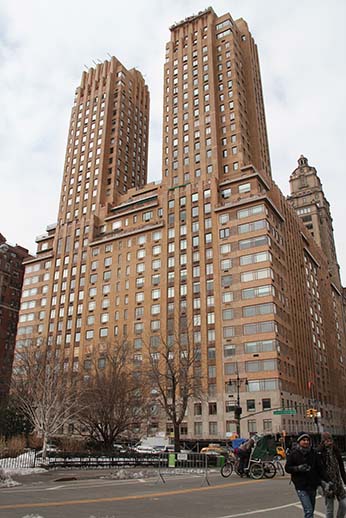
For his bid for legitimacy, he targeted the newly constructed 32 story Majestic Apartments, a twin towered, brick and steel framed art deco masterpiece. Located at 115 Central Park West across the street from the famous Dakota, nothing in the city was more modern and posh than the Majestic.
For their home, Costello and his wife, Loretta Geigerman, selected apartment 18F, a nine room, two bedroom, two bathroom, corner apartment facing Central Park, which they rented for $3,900 a month (the apartment recently sold for $5,304,000).

The view from Frank Costello’s apartment was majestic.
Because of the building’s unique cantilevered construction, there were no columns to block Costello’s view of the park and the breathtaking full morning sunlight that the mobster rarely tasted during his youth in the slums of East Harlem.
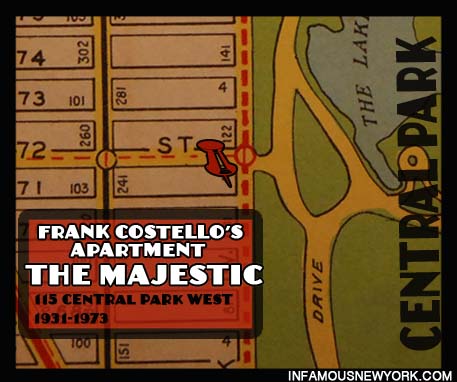
Frank Costello lived in apartment 18F in the Majestic Apartments. Vincent “Chin” Gigante attempted to assassinate him in the lobby in 1957.
The couple hired James Mont, the mob’s top interior decorator, to deck the apartment out in mafia glitz. Mont hung a Howard Chandler Christy “Christy Girl” oil painting over the fireplace. Next, he placed a gold plated grand piano in the living room and ringed it with slot machines manufactured by Costello’s True Mint Novelty Company, a firm that reportedly earned the mob mogul $500,000 a day. But the one-armed bandits in Costello’s lavish pad had a unique twist: they were rigged for perpetual jackpots. Costello was known to say to guests such as publisher Generoso Pope Jr. and future New York Mayor Bill O’Dwyer,
What do you think I am, a punk? Nobody loses in my house.
Over the years, Costello would integrate himself in the parade of rich and famous neighbors like: the diamond merchant: Jacob Baumgold, shoe magnate: Andrew Geller, Fred Astaire, Milton Berle, Zero Mostel, and his arch rival—newspaper reporter Walter Winchell. Whenever he needed a cup of sugar, Costello could visit his pal Bugsy Siegal downstairs.
From this majestic incubator, Costello’s power would only grow. In 1936, Lucky Luciano was sentenced to 30 to 50 years for compulsory prostitution. A year later Vito Genovese fled to Italy fearing murder charges, leaving Frank Costello boss of the Luciano Crime Family.
For the undisputed king of Manhattan nightlife, Costello was an early riser. Waking at 9:00 am every morning, his daily ritual included a trip to the Waldorf Astoria Barber Shop for a shine, shave, and a manicure followed by lunch at the Madison Hotel. On Thursdays he hit the baths in the subbasement of the Biltmore Hotel for “the works”, sauna, steam room and a massage.
He saw a psychoanalyst once a week and became a major donor to the Salvation Army, turning over the Copacabana night club for their holiday fundraisers. Wire taps placed on Costello’s home phone by D.A. Frank Hogan recorded New York supreme Court Justice Thomas Aurelio pledging his undying loyalty to the mob boss.
Just as the former bootlegger was ready to climb into the seat of respectability, things began to unravel. In 1951 Senator Estes Kefauver’s travelling committee rolled into town and hauled Costello in front of television cameras, forcing Costello to answer several difficult questions such as if he kept $50,000 in a safe in his apartment. Costello replied,
I believe I had a little strongbox… I keep forty-fifty thousand.
Refusing to answer anymore questions, the Prime Minister of the Underworld stormed out and was slapped with contempt of court and a 14 month prison sentence. Soon the IRS was on his tail, and INS wanted to revoke his citizenship.
When Costello returned from prison, he had even more problems. Vito Genovese had returned from Italy, gunning for Uncle Frank. On the evening of May 2nd, 1957, Genovese struck. As Costello walked into the Majestic’s zinc and marble lobby, Genovese’s chief bully-boy, Vincent “The Chin” Gigante, pulled a revolver and screamed:
This is for you Frank.
Just as Gigante fired a single round, Costello spun around, and because of some quirk of physics, geometry, and the hand of God almighty, the bullet grazed Costello’s scalp, riding around the rim of his borsalino hat. The attack left Costello shaken. He quickly sued for peace with Genovese, and retired from the rackets. Costello would live in the Majestic until his death in 1973


Posted in Five Families, Frank Costello, Lifestyles of the Rich and Infamous, Lucky Luciano, Mafia, Prohibition, Vincent “The Chin” Gigante | Tagged 115 Central Park West, Bill O’Dwyer, Copacabana nightclub, Estes Kefauver, Frank Costello, Frank Hogan, James Mont, Kefauver Commission, Kefauver Committee, Lifestyles of the Rich and Infamous, Lucky Luciano, The Majestic Apartments, True Mint Novelty Company, Vincent “The Chin” Gigante, Vito Genovese, Walter WInchell | 4 Comments »

Frank Costello on Racketeers

Posted in Uncategorized | Leave a Comment »
When Herbert Asbury’s Gangs of New York last left readers with Thomas “Humpty” Jackson, the crooked hunchback gnome known for packing a revolver in his hat and a copy of Voltaire in his pocket, the gangster was composting in a prison cell upstate.
But what Asbury never told readers was that Humpy spent his three year stretch reading every book he could get his thieving paws on. Stevenson, Huxley, Darwin, Herbert Spencer, and Thomas Paine, Humpty devoured every volume in the Sing Sing library, and when he got out; the Hump decided to go straight.
Surrounding himself with books, pigeons, and toy poodles, Jackson eventually opened a pet shop on 125th Street where the mug dispensed a blend of streetwise philosophy and classical learning to anyone who would listen. Soon, he was being courted by Colliers magazine, The New York Times, The Washington Post, and a dozen little rags from around the country that all came to sop up Humpty’s wisdom on subjects as diverse as: love, prohibition, capital punishment, and the secrets of life. These are his greatest hits:
Click for more posts on Humpty Jackson

Humpty Jackson on the Transformative Power of Reading

Posted in Gangs of New York, Humpty Jackson | Tagged Gangs of New York, Herbert Asbury, Humpty Jackson, Prison | Leave a Comment »
 Infamous New York