Feeds:
Posts
Comments

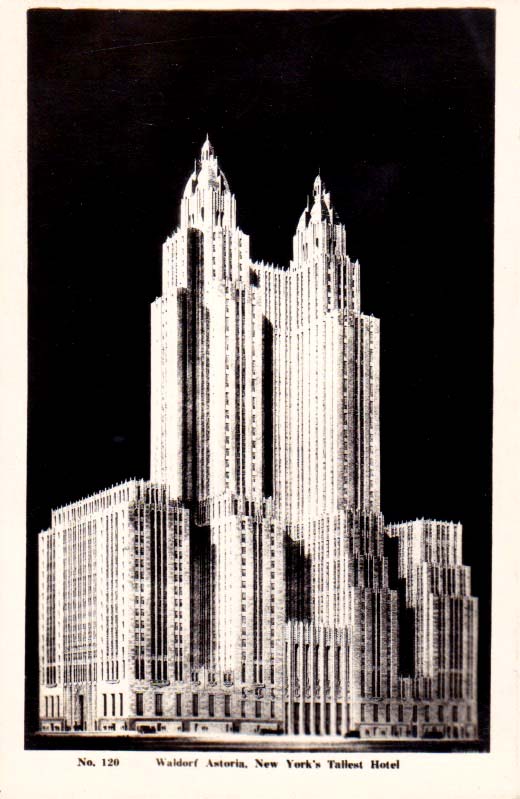
Lucky Luciano Apartment Waldorf Astoria

Status: Standing

Location: 301 Park Avenue, Suite 39C


Sidestepping bullets, one-way rides and innumerable gang wars, he grew to be the master of prohibition era New York. He was vain, narcissistic, and volatile, a textbook sociopath, but he was also fabulously wealthy, an attribute about which most people could not boast during the Great Depression.


By the mid-1930s, Salvatore Lucky Luciano wanted to kickback and enjoy the fruits of his ill-gotten swindles. He had outgrown his “modest” suite in the Barbizon Plaza overlooking the Lake in Central Park and he wanted something a little nicer.


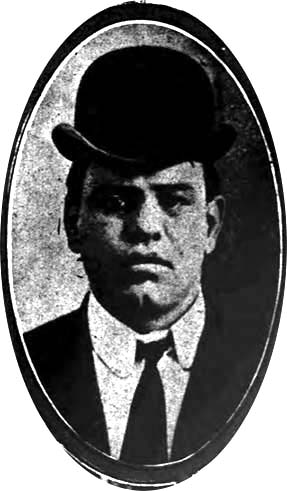
800px-Lucky_Luciano_mugshot_1931


The Toniest Address in New York


Driven by a massive inferiority complex, Lucky needed something bigger, something better, something swankier. He wanted no less than the toniest address in the whole City of New York. He wanted to live in the Waldorf Astoria Towers.


He later reminisced to Richard Hammer and Martin Gosch, authors of The Last Testament of Lucky Luciano:

 “I figured if everybody was gonna call me the boss, I was entitled to live in an apartment that was above Frank’s… the Towers was the best class address in New York.”

According the to Waldorf’s website:

“The Waldorf Towers represents the pinnacle of New York grandeur, with a long-established legacy of providing guests with exceptional privacy and personalized service.”


Privacy and personalized service were exactly what Luciano received at the Waldorf. He rented apartment 39C as Mr. Charles Ross and paid his $800 a month rent in hundred dollar bills.


Lucky Luciano Apartment, Frank Costello, Longy Zwillman, Meyer Lansky

Lucky Luciano lived in apartment 39c under the alias Charles Ross.


The gang lord could count on secrecy in his rooms where he entertained the moguls of the mob such as Longy Zwillman, Tony Bender, Vito Genovese, Meyer Lansky and Frank Costello. His criminal conspirators could then sneak out of Lucky’s pad and disappear into the city through the hotel’s packed arcade. A parking garage allowed the gangster to park his car and ride a private elevator to his room.


Lucky Luciano Waldorf Hotel


For kicks, Lucky would give the famed madam Polly Adler a ring and she would dispatch her best call girls. When Lucky felt more domestic, he spent evenings with his showgirl girlfriend, Gay Orlova.


Waldorf Int


It was a gangland dream come true, but things nearly went south when one of Lucky’s goons showed up at the front desk asking for Charlie Lucky. An outraged clerk stormed up to Luciano’s suite demanding answers.


Lucky recalled in The Last Testament of Lucky Luciano:

“…I knew the towers wasn’t gonna throw me out. After all, I was payin’ my rent regular, which was more than they could say about some of the bluebloods that was freeloadin’ there. So I figured it was payoff time.”


Greasing the Waldorf’s Wheels

Lucky placed the Astoria’s desk clerk on the payroll, greasing him with $200 a month.The bribes eventually paid off in March of 1936 when detectives from Thomas E. Dewey’s office stormed the lobby looking for the gangster. The clerk tipped off Luciano, and he hopped into his private elevator and roared off in his car.


Dewey eventually caught up with Lucky Luciano in Hot Springs Arkansas. He was sentence to 30 to 50 years for operating a massive prostitution ring. Lucky was sent to the frigid Dannemora Prison on the Canadian border where hoped for a day when he could return to linens, massages and private elevators.


Luciano would eventually return to the lap of luxury courtesy of the United States Navy.

Infamous-New-York-240-Centre-Street-Old-Police-Headquarters

Location: 240 Centre Street

Status: Landmarked (click for landmark report)


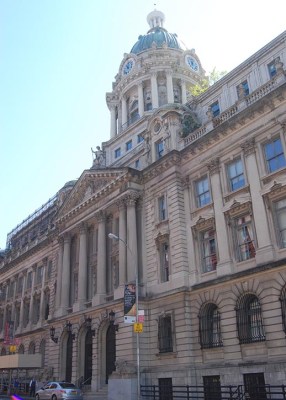
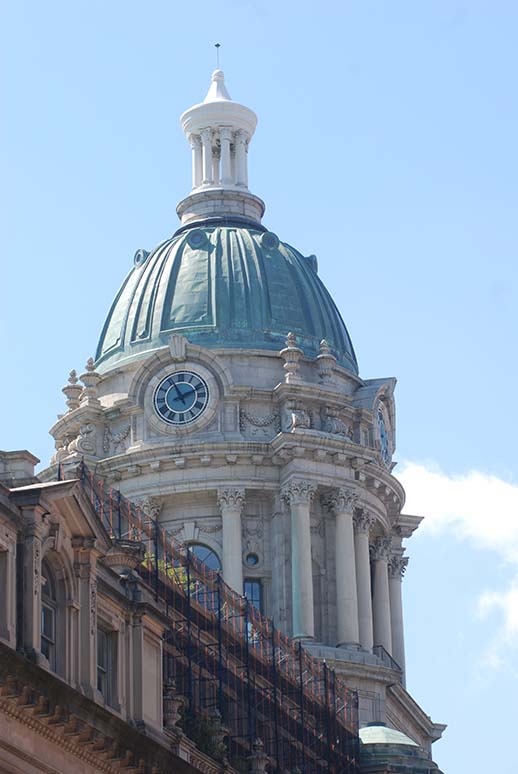
For over sixty-four years, police officers called it the big white castle, the nerve center of the nation’s largest and most sophisticated police department. Over the years, the New York City Police Department’s Centre Street headquarters would combat mobsters, bootleggers, jewel thieves and serial killers.


Built by the architectural firm: Hoppin, Koen and Huntington for approximately $750,000, Old Police Headquarters, or the Central Office as it was once called, represents one of the most beautiful Beaux-Arts masterpieces Manhattan has to offer.


The architect, Francis Hoppin stated:

“The building was not intended to look like a police station, but was inspired by the dignity of City Hall, the handsomest building on Manhattan Island… designed to impress both officer and prisoner…with the majesty of the law.”


Old NYPD Headquarters Infamous New York 240 Centre Street Police Building

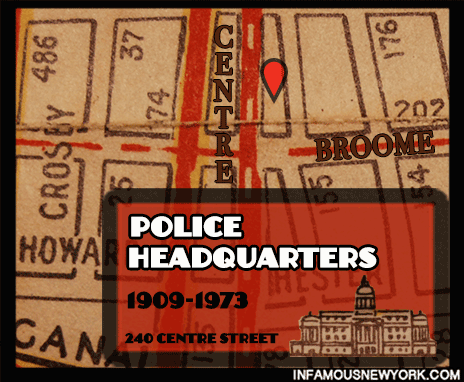
The New York City Police Department headquarters stood at 240 Centre Street from 1909 to 1973.


Built between 1905 and 1909 on a wedge shaped parcel of land bounded by Grand, Centre and Broome Streets where the old Centre Market had stood since 1817, the new Headquarters was needed following the consolidation of the five boroughs in 1898, when the police force quadrupled in size.


240 Centre Street Old Police Headquarters Infamous New York 2


On midnight November 29, 1909, Police Commissioner William F. Baker inaugurated New York’s era of scientific policing when telephone switchboards at the old police headquarters at 300 Mulberry were simultaneously shut down and transferred to the new Central Office.


240 Centre Street Old Police Headquarters Infamous New York


On the first floor of 240 Centre Street, visitors would find an ornate reception room. To the left of reception, guests could find the Chief Inspector’s office, the Bureau of Information and the Boiler Squad, a NYPD unit responsible for testing steam heaters in buildings throughout the city.


NYPD, Old Police Building, 240 Centre Street, Police Headquarters

The old New York Police Department headquarters was located at 240 Centre Street.

To the right of the reception room, the chief detective’s office could be found next to the line up room for criminal suspects, the homicide room and Lt. Giuseppe “Joseph” Petrosino’s famed Italian Squad.


The Italian Squad


Formed to investigate the growing threat of a criminal organization known as the Black Hand, Lt. Petrosino and his Italian speaking squad uncovered the existence of a secret criminal society known as the Mafia lurking in the shadows of New York’s Little Italy. Assassinated while investigating the Mafia in Sicily, Petrosino never had the chance to see the new Police Headquarters.


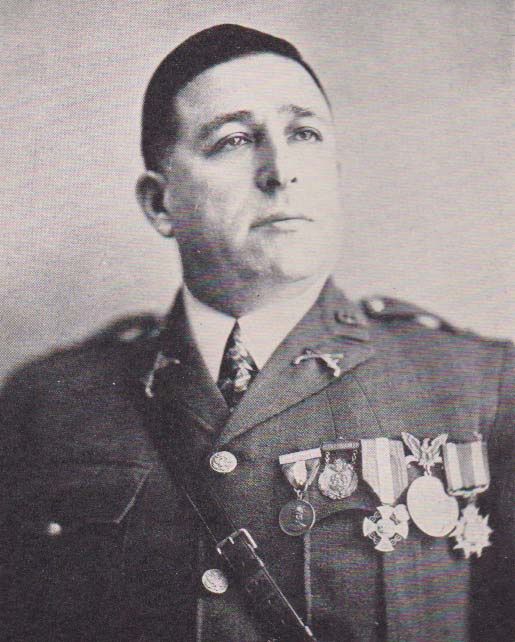
Michael Fiaschetti 2 Italian Squad Infamous New York

After the assassination of Joseph Petrosino, Michael Fiaschetti took command of the Italian Squad at 240 Centre Street.

Petrosino’s second in command, Michel Fiaschetti ran the Italian squad from 240 Centre street well into prohibition when the unit was disbanded. In addition to combating the Mafia, the Italian squad developed the nation’s first bomb squad to defuse bombs planted to extort Italian shopkeepers.


On the Second floor of Police Headquarters was the Commissioner’s office and the Bureau for Theatrical Licenses. On June 10, 1970, a bomb planted by the Weathermen exploded in a bathroom on the floor, blowing out windows and injuring eight people. (Click to read the story)


Another flight up was the Chief Clerk’s offices and a police science library, a room stocked with the most up to date texts on investigation, forensics and criminal identification.


The Police Academy


Housed on the fourth floor, the City’s Police Academy operated at 240 Centre street until it moved to 400 Broome Street in 1928. The facilities included a gym, a drill room, heavy bags and a running track.


The NYPD’s Nerve Center


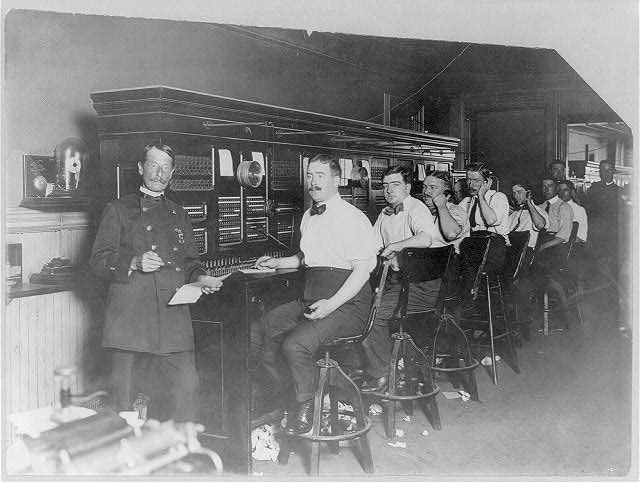
The fifth floor existed as the Police Department’s nerve center, housing a sophisticated switchboard and dispatch system for the entire city. According to the New York Evening Post:


“The Switchboard is the most complete and costliest in the world, and every known improvement in telephones will be found there.” —New York Evening Post


3a46281r

Equipped with the latest technology of its time, the switchboard room was located on the 5th floor of 240 Centre Street.


Nearby in the Bertillon room, officers photographed and meticulously measured and recorded different parts and components of known criminals’ bodies. Their findings were then printed on 5”X3” index cards, an early system of criminal identification, and sent to the Old Police Headquarters’ Rouges Gallery. Fingerprinting eventually replaced the Bertillon system.


3b37174r

The Rouges Gallery in 240 Centre Street. After criminal identification cards were created, the documents were stored here.

Secrets Beneath 240 Centre Street


The cellar boasted a pistol shooting range, the property clerk, 72 cells for high profile Detective Bureau prisoners, and most notably a secret tunnel. During prohibition, officers went to great lengths to get their drink on, digging a tunnel under Centre Street to O’Neill’s tavern so that the coppers could drink in uniform. Parts of the tunnel live on today as a wine cellar.


Gun Dealer’s Row


Almost overnight, gunsmiths and gun dealers sprouted up behind headquarters on Centre Market Place where officers could buy guns, billy clubs and uniforms. Famous gun dealers such as John Jovino and Frank Lava operated here for many years. According to the Village Voice:


“At one time, six gunsmiths—all Italian—operated out of storefronts along that block, A few yards down Broom Street, a single German plied the trade”—The Village Voice (click to read the article)


The Police Department officially closed 240 Centre Street in 1973, moving headquarters to 1 Police Plaza. Rather than relocating the historic records into an archive, the department unceremoniously dumped a half-century worth of police records into the East River. Headquarters was later converted into a luxury apartment building named the Old Police Building.

Socks Lanza, Yakey Yake Brady, Fulton Fishmarket, South Street Seaport, Corlears Hook, The Bridge Café, Roxy Vanella, Vito Genovese, Lucky Luciano, NYPD, Harbor Patrol, Socco the Bracer, Patsy Conroy, Saul and Howlett, River Pirates, Paris Cafe, NYPD Museum

Click to enlarge map in a new window.

Murder, mayhem and river pirates are not among the listed tourist attractions at Manhattan’s South Street Seaport, but that’s exactly what a sightseer would have encountered during much of the district’s history.

Once a major port in the 1800s, this salty strip of land on the East River attracted merchantmen from around the globe for its deep waters and ice free docking, but with millions of dollars of cargo arriving daily came the dreaded specter of New York’s earliest organized crime syndicates—river pirates.

Today’s boutiques were once brothels and the gastro pubs rum holes. To walk these streets at night was to play a real-life game of Lets Make a Deal. Behind door number one: a whorehouse. Behind door number two: a dog-fighting pit. Behind door number three: shanghaiing, murder and death. Allow this South Street Seaport Walking tour to take you back to the days when river pirates and mobsters ruled South Street.


Gangs of the South Street Seaport Walking Tour Map


1 First Precinct: NYPD Museum

Location: 100 Old Slip, www.nycpolicemuseum.org

Status: Closed for Renovation

1st precinct 20

There’s probably no better place to start a tour of the criminal history of the South Street Seaport than the New York City Police Department museum. Sandwiched between looming skyscrapers, the landmarked 1909 neo-Renaissance First Precinct building represents the first modern police building in the U.S. and a must see for law enforcement buffs. Usually ringed with vintage NYPD vehicles parked curbside, the NYC Police Museum is under restoration because of flooding during Hurricane Sandy. When it reopens, guests will be treated to vintage uniforms, Willy Sutton’s lock picks, old mug shots, and the Tommy gun used to assassinate Frankie Yale.


2 Fulton Fish Market

Location: Pier 18 South Street

Status: Landmarked

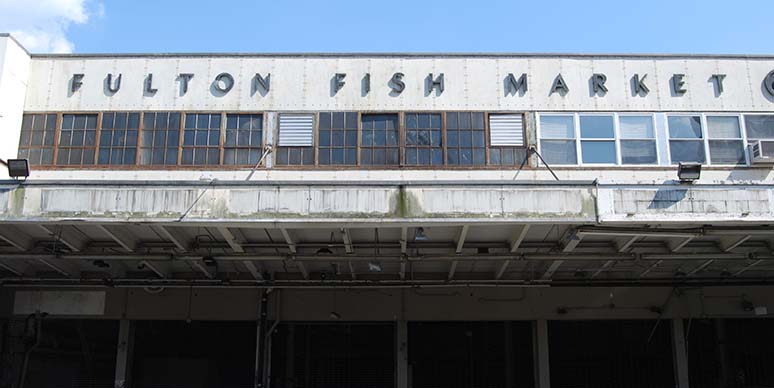
Fulton Fishmarket Project Underworld Navy and the Mafia WWII

It was the heart of the Seaport and the queen of South Street, an insular, self-regulated 188-year-old world populated by fishmongers and scoundrels and sea captains and Mafiosi. Now desolate and rusty, the battered, but landmarked, corrugated metal Tin Building on Pier 17 once stood as the district’s high temple of brine. If you get there early enough and squint into rising sun you might see them, the ghosts of the fish men who toiled from 1822 to 2005 in their blood spattered aprons under the predatory gaze of the gangs of New York.

The Mafia arrived in 1919, when a twenty-year-old character exploded onto the scene. His name was Joseph Lanza, but his mafia co-workers called the 230-pound bulldozer “Socks” because of the knockout force in his meat hooks. With the help of his knuckles, the mobster organized the United Seafood Worker’s Union, Local 202, and a goon squad incorporated as the Fulton Market Watchmen and Patrol Association on behalf of Joe “The Boss” Massaria and later Lucky Luciano and Vito Genovese. Lanza died in 1968 amid the constant probes of both federal and state organized crime task forces.

The Romano twins, Carmine and Vincent, picked up where Socks left off, extending the reign of the Genovese crime family into the late 1990s. The Federal Government convicted the Romano’s for violations of the Taft-Hartley anti-monopoly act in 1981, which paved the way for Rudolph Giuliani to initiate a lawsuit that placed the Fish Market under Federal Custodianship. In 2005, the reek of fish and crime wafted from the Fulton Fish Market for the last time when the entire industry packed up for the Hunt’s Point in the Bronx.


3 Water Street

Location: Water Street

Most visitors who stroll over the uneven cobblestones of Water Street fail to realize that the social reformer Oliver Dryer once called this thoroughfare:

“…the wickedest block in the wickedest ward in the wickedest city in America…” –Oliver Dryer

By the mid-1800s, Sailors arrived daily on Water Street to booze and whore the night away, but the seamen were always one step away from death. Consisting of one block of bars, brothels, rat pits and gambling dens, Water Street existed as the nexus of waterfront crime—a place where pirates plotted their next score, fixed elections and wrapped the corpses of murdered sailors in chains for disposal. On Water Street violence was endemic. The dives and whorehouses and hellholes that lined this street had fitting names. There was Long Marry’s at No. 275 and Mother McBride’s at No. 340, but none were more infamous than Kit Burn’s Rat Pit.


4: Kit Burn’s Rat Pit

Location: 273 Water Street

Status: Landmarked

Web Kit Burns the Ratpit today 273 Water Street

Now luxury apartments, 273 Water Street once represented the heart of Water Street’s “sporting culture. Officially named Sportsmen’s Hall, Kit Burn’s Rat Pit existed as New York City’s premier dog fighting and rat baiting venue. In the pit, a gaslight illuminated octagon, eighteen inches high, sixteen feet long, and eight feet wide, Kit pitted dogs against dogs and terriers against gigantic wharf rats in gladiatorial matches that would have made the Ancient Romans blush.

The pit was a family affair, and Kit ran business with his wife and daughter, Kitty, a dame well acquainted with the business end of a wooden club. For fun Kit brought in his son-in-law Jack the Rat, a character who would bit the head off a rat for a quarter a chomp. Henry Bergh, founder of the ASPCA, eventually put the bite on the Rat Pit and closed the establishment with the help of the NYPD. For a longer story on Kit Burn’s Rat Pit: https://infamousnewyork.com/2013/10/22/kit-burns-rat-pit/


5: The Bridge Café

Location: 279 Water Street Status: Closed for Renovation

http://bridgecafenyc.com

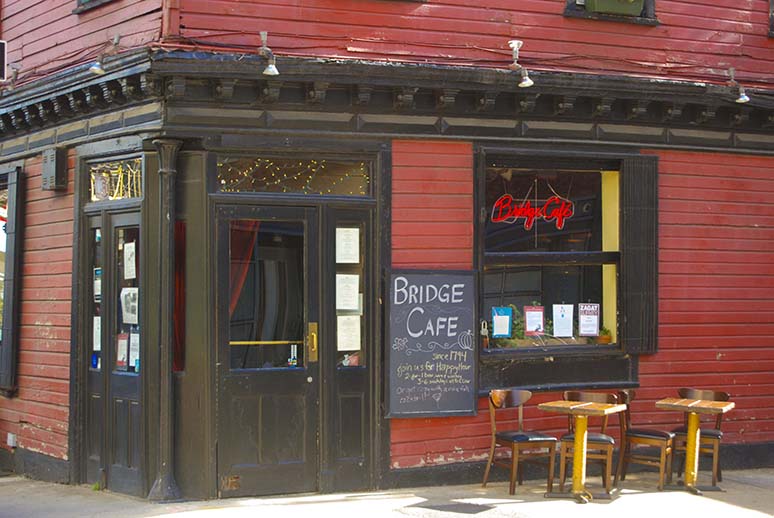
Bridge Cafe, 279 Water Street, Gallus Mag, River Pirates, South Street Seaport

The Bride Café on Water Street was once known as the Hole-In-The-Wall Saloon, a vicious den of 19th century depravity.

Nearly destroyed by Hurricane Sandy, the Bridge Café exists as New York City’s last remaining pirate bar. Back in the 1870’s, the café was called the Hole-in-the-Wall Saloon. Owned and operated by Jack Perry and his wife, Mag Perry, the infamous Gallus Mag. A suffragette, before women’s suffrage became popular, Gallus earned her nickname from the unthinkable act of wearing trousers, rather than dresses, and holding them up with galluses or suspenders. When clients gave her trouble, Gallus often bit off their ears and dropped them in a pickling jar behind the bar. One-Armed Charley Monell later took over the bar and converted the upper floors into a brothel. By the 1900s, the Bridge Cafe became a hangout for the Yakey Yake Brady gang. For a longer story Gallus Mag the Bridge Café: https://infamousnewyork.com/2013/11/14/save-the-bridge-cafe-new-york-citys-last-pirate-bar/


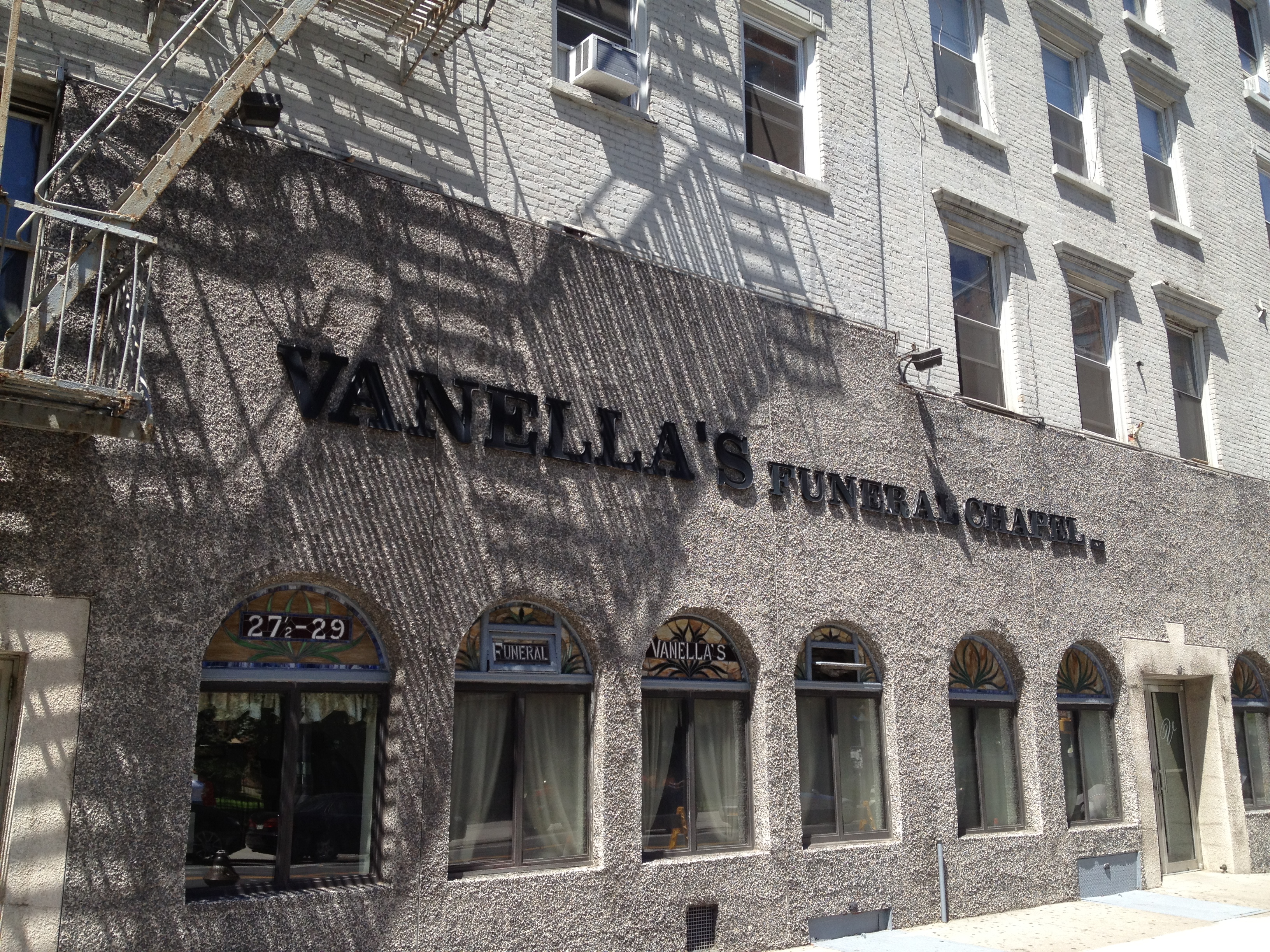
6: Vanella’s Funeral Chapel

Location: 29 Madison Street Status: Open

IMG_0100

An original member of Johnny Torrio’s James Street Gang, Roxie Vanella (Namesake of Vanella’s funeral chapel) followed Torrio to Chicago, leaving a crime spree in his wake. After killing a corrupt police officer and beating the charges, Vanella returned to Corlears Hook in New York and opened this funeral chapel at 29 Madison Street. For the complete story on Roxie Vanella: https://infamousnewyork.com/tag/vanellas-funeral-chapel/


7: Yakey Yake Brady and the Rumble for Cherry Street

Location: Cherry Street

Yaley Yake Brady

They came from the west with plunder on their minds and bucking revolvers in their hands. It was hard to say why in the spring of 1903 the thousand strong Monk Eastman mob turned their greedy paws on the slums of Cherry Street, but for John “Jake Yakey Yake” Brady it meant war.

Raised in the shadow of the Brooklyn Bridge, Yakey Yake carved out a fiefdom in the Irish slum known as The Gap in the northerly hollow of Cherry Street. A former jockey and barrel maker, Brady’s professions didn’t prevent him from mixing it up with the rowdies. Arrested dozens of times for scores of “accidental” and intentional shootings, Brady became the most feared man in Corlears Hook with a reputation so dreadful that when a longshoreman pressed assault charges on Yake; the dockworker hanged himself rather than face the hoodlum’s retribution.

When Monk Eastman came for Yake’s waterfront kingdom, the blood of gangsters turned the East River red. As the New York Sun put it:

“Under the bridge, revolver shots have echoed by twos and threes and by hundreds.”—The New York Sun, 1903

Because of the Monk’s superior numbers, Yake formed an alliance with Eastman’s perennial rival, Paul Kelly’s Five Points Gang, who had a nearby outpost on James Street garrisoned by Johnny Torrio and Roxy Vanella. To dam the tsunami of violence, the police ringed the district with undercover officers with orders to frisk and arrest any armed goons. The cops put Yakey Yake under such pressure that the gang leader wagered his barrel making firm on a card game and won a wagon team that he used to relocate to Jersey City, where he died in 1904.


8: The Sinking of Socco the Bracer

Location: Pier 27, Foot of Jackson Street

Flash, fire and smoke, lit up the night sky on May 29, 1873, when members of the Patsy Conroy mob exchanged gunfire with the harbor police at Jackson Street’s Pier. Earlier that evening, Joseph “Socko the Bracer” Gayle, Danny Manning, and Benny Woods hijacked a rowboat and rowed out in search of the ship, Margaret. Two skiff-borne harbor cops noticed the river pirates scampering up the ship’s anchor chain. Officers Musgrave and Kelly opened fire.

The rogues dove into their rowboat and pulled away into the darkness. A champion rower, Officer Musgrave gave chase while his partner scanned the horizon with a lantern, which was greeted by a pistol blast. The police answered with their six-shooters and traded broadsides with the thugs like a man-o’-war until a bullet tore through Socko. His companions pitched him overboard and the river bandit sunk to the bottom like a lead plated mackerel. The authorities apprehended Benny Woods the next day. Unfortunately, the Margaret sailed for China with the witnesses, ending any chance of a conviction.

9: Murder on the East River: The Saul and Howlett Story

Location: East River, Foot of Oliver Street

On the night of August 25, 1852, a pistol shot rang out from the Thomas Watson, a cargo ship anchored at the foot of Oliver Street. As Charles Baxter, the ship’s night watchman bled to death, two pirates rifled through the dying man’s clothing. The thieves then heard the rapping of a police nightstick against the cobble stone street, the signal for reinforcements in the days before police whistles.

A dozen lantern-carrying police officers sprinted to the scene, collaring William Saul and Nicholas Howlett, two river-borne rogues that Herbert Asbury incorrectly identified as leaders of the Daybreak Boys. (Former Chief of Police George Walling believed that the two men were the leaders of the Hook Gang) Whatever their affiliation, Saul and Howlett terrorized the waterfront for over a decade and the Chief credited the pair with twenty murders. The Baxter murder; however, would become one of the most sensational stories of the decade, signaling the end of the East River pirates. Saul and Howlett were found guilty of the murder were hanged in the Tomb’s courtyard on January 28, 1853. Bill “The Butcher” Poole attended the hanging to wish his river pirate friends farewell.


10: The Wickedest Man in America:

John Allen’s Dance Hall

Location: 304 Water Street

Status: Demolished

Wickedest Man in New York, John Allen. 304 Water Street, Brooklyn Bridge, South Street Seaport, Corlear’s Hook, 4th Ward, Westley Allen, Wess Allen, The. Allen, Theodore Allen, Gangs of New York, Herbert Asbury, Gangs of New York, Saloon

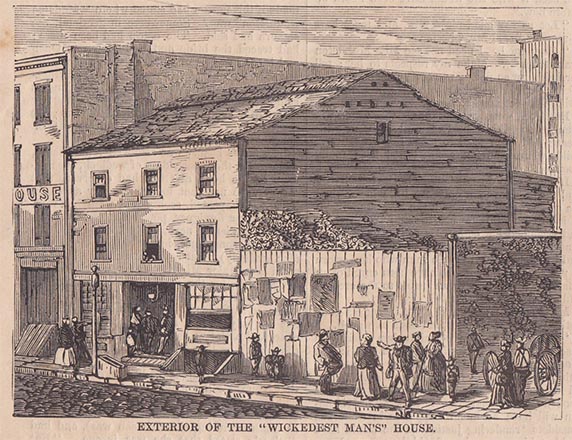
Priests, police and just about everyone else in New York City called John Van Allen the wickedest man in New York, and he reveled in it. In less than twenty years, Allen amassed over 113 arrests for running disorderly houses across the city, but his most infamous den was this now demolished Water Street dancehall.

The three-story bordello at 304 Water Street offered several dance floors, an orchestra pit and booths for sex serviced by Allen’s crew of twenty ladies of the night. A natural self-promoter, Allen set the tabloids aflame with his wacky antics even attracting the attention of Mark Twain who described Allen as, “a tall, plain, boney, fellow, with a good-natured look in his eye, a Water Street air all about him, and a touch of Irish in his face.” In reality, Allen probably wasn’t the wickedest man on Water Street by a long shot (his brother’s The. And Wes were far more wicked), but after his ceaseless campaigning for the title, the moniker stuck when the fishmonger transformed his whorehouse into New York City’s wackiest religious revival.


11 The NYPD Harbor Patrol

The murder of the ship watchman Charles Baxter by the infamous desperados Nicholas Howlett and William Saul alerted the public to waterfront crisis. Chief Walling commented on his battles with Saul and Howlett in his autobiography. He wrote,

“My investigations in this murder opened up to me a chapter in the annals of crime, of full horrors of which I never dreamed…human monsters prowled around our river fronts…who thought no more of the life of a man than that of a chicken.” Police Chief George Washington Walling

Following the Saul and Howlett case, the Police Department organized its first harbor patrol of several rowboats and took the war to the seas. The department purchased a steam ship named the Deer, which functioned as a fulltime floating station house. In 1858, the Metropolitan Police Force expanded the harbor unit to 57 men, six rowboats and the paddle wheel steamer, Senica. The men of the harbor police used to joke that the steamship was only fast when she was tied to the pier. The Senica was an abject failure that only made one arrest before burning to the waterline in 1880. Despite the failure of the flagship, the harbor force brought the pirates to their knees, pacifying the waters of the East River by the turn of the century and driving crime to the shores.


12 Meyer Hotel, The Paris Café and Project Underworld

Location: 119 South Street

Status: Landmarked

To complete your tour of the South Street Seaport, step into the Paris Café and have a drink at its original, hand-carved bar and ponder its history. Home to longshoremen, sea captains and mobsters, the Paris Café has served beer since 1873.

Constructed by alcohol merchant Henry Meyer, the Meyer Hotel and its Paris Café stood out as the poshest hotel and bar in the district. Thomas Edison, Annie Oakley, Buffalo Bill, Butch Cassidy, the Sundance Kid and Theodore Roosevelt all spent time in the building before beginning voyages to Europe and South America. When the passenger steamship lines moved their docks to the new Chelsea Piers terminal, the hotel fell into disrepair and the mafia took control.

By the 1930’s, Albert Anastasia and Louis Lepke Buckhaulter regularly met in the bar. Upstairs in the hotel, Socks Lanza orchestrated his fish empire. Socks controlled the Seaport with such impunity that the U.S. Navy came calling for the racketeer in the 1940s with an unusual proposition. They wanted him to help fight the Nazis.

Eventually with Lanza’s help, naval agents embedded themselves on the Atlantic fishing fleets to observe German submarines. Lucky Luciano was even contacted in Dannemora prison to help plan the invasion of Sicily.

For more information on Project Underworld: Allegiance between the Navy and the Mafia.
New York Prison Archives Digitized- Free to New York Residents
http://ow.ly/H09Uc

07SINGSING-articleLarge

Prohibition, Monk Eastman, Lower East Side, Prohibition, Gangs of New York, Blue Bird Café, Jerome Charyn, Gangsters and Gold Diggers, Neil Hanson, Jerry Bohan, Prohibition Agent, Blue Bird Café, Union Square Subway Station, Crime, Murder, World War I, WWI, death,

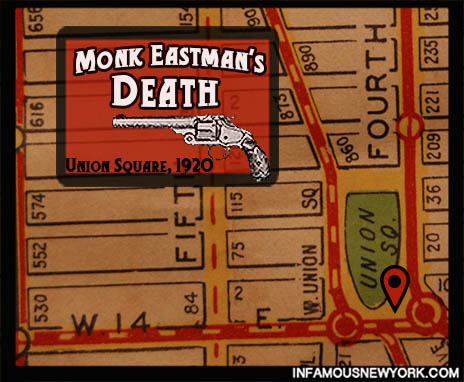
Location: Union Square, Fourth Ave and 14th Street

Status: Standing

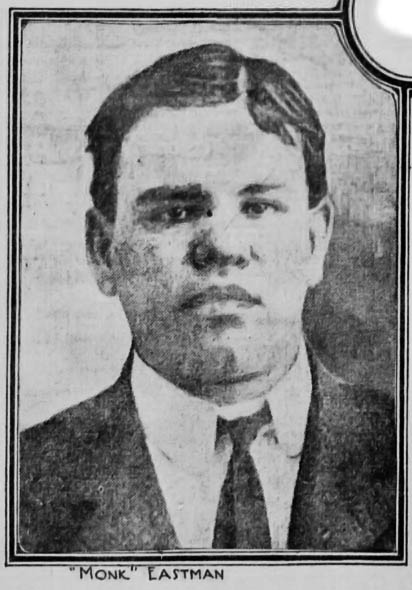
‘Twas the morning after Christmas, 1920, when police officers stumbled on the lifeless body of Monk Eastman sprawled out in a gutter just south of the Union Square subway station. One of the toughest mugs in New York City’s history, the Monk had survived half a dozen street wars up and down the Lower East Side, several terms in Sing Sing, and the trenches of WWI. (Click to read about Monk Eastman in WWI)

Monk came back from the war a hero and won a full pardon from Governor Alfred E. Smith, but now several weeks later; Eastman was dead.

Prohibition, Monk Eastman, Lower East Side, Prohibition, Gangs of New York, Blue Bird Café, Jerome Charyn, Gangsters and Gold Diggers, Neil Hanson, Jerry Bohan, Prohibition Agent, Blue Bird Café, Union Square Subway Station, Crime, Murder, World War I, WWI, death,

Monk Eastman died in the gutter of Union Square.

Boozing at the Bluebird Cafe

Christmas evening began like most days for Eastman, with a little prohibition-era binge drinking at the Bluebird Cabaret, No. 62 East 14th Street. Monk and a pack of heavies, including corrupt Prohibition Agent, Jerry Bohan, strolled into the Bluebird, sat at their reserved table and got merry. According to Neil Hanson, author of Monk Eastman, Monk boasted to a showgirl:


“Do you know who I am? I’m Monk Eastman, the gang leader who made good…” –Neil Hanson, Monk Eastman

Prohibition, Monk Eastman, Lower East Side, Prohibition, Gangs of New York, Blue Bird Café, Jerome Charyn, Gangsters and Gold Diggers, Neil Hanson, Jerry Bohan, Prohibition Agent, Blue Bird Café, Union Square Subway Station, Crime, Murder, World War I, WWI, death,

Monk Eastman had survived turn of the century street wars of the Lower East Side, and the trenches of the First World War, but on the morning after Christmas, 1920; Eastman was found face down in the gutter.

The Brain’s Brawn- Arnold Rothstein and Monk Eastman

But the $144 bankroll in his pocket, the fine Witty Brother’s suit and the gold spectacles found on Eastman’s body told another story. Eastman had hired his fearsome reputation out to the highest bidder, and that bidder turned out to be the Brain of Broadway, Arnold Rothstein. Jerome Charyn noted in Gangster and Goldiggers,


“It seems the Monk had been bootlegging and selling dope for The Brain. A.R. was never implicated, of course.”—Jerome Charyn, Gangsters and Gold Diggers

Prohibition, Monk Eastman, Lower East Side, Prohibition, Gangs of New York, Blue Bird Café, Jerome Charyn, Gangsters and Gold Diggers, Neil Hanson, Jerry Bohan, Prohibition Agent, Blue Bird Café, Union Square Subway Station, Crime, Murder, World War I, WWI, death,

Eastman was once the prince of the Lower East Side, but opium addiction and prison sentences destroyed his kingdom.

Monk Eastman a Rat?

Emotions were high at the Bluebird that night. Monk Eastman was running his mouth about quitting crime, making good and becoming an honest citizen, talk that made his bootlegger pals nervous. Little did he know, Eastman’s buddies had put him on the spot, and Bohan was the trigger-man.

When Eastman drunkenly stumbled onto the street, Bohan followed with a .32 caliber pistol in his hand. Just as Eastman crossed 14th street, the crooked Prohibition Agent opened fire into Monk’s back.

An eyewitness described the scene:

“A man was standing over him and as we reached the window we saw him fire four more shots into the man on the sidewalk… the murderer bent over his victim a moment, presumably to make sure he was dead…”

Bohan then hopped into a waiting taxicab and sped off into the night. Several days later, under the pressure of a police manhunt, Bohan walked into the Lee Avenue police station in Brooklyn and confessed to the crime, claiming self defense as his motive. The corrupt Prohibition Agent was sentenced to three to ten years for manslaughter (Click for newspaper story) and Eastman was buried with full military honors in the gangland funeral of the decade.

In Bohan’s version of the crime, the corrupt Prohibition Agent shot Eastman in self-defense.

In Bohan’s version of the crime, the corrupt Prohibition Agent shot Eastman in self-defense.

Infamous New York, Crime Scenes, NYC

Click Here
To Follow Infamous New York

Lucky Luciano, Dutch Schultz, Owney Madden, Mad Dog Coll, Vincent Coll, Salvatore Maranzano, Mayor Jimmy Walker, Harlem Baby Massacre, Michael Vengalli, Joey Rao, Joseph Bonnano, Big Frenchy DeMange, Peter Coll

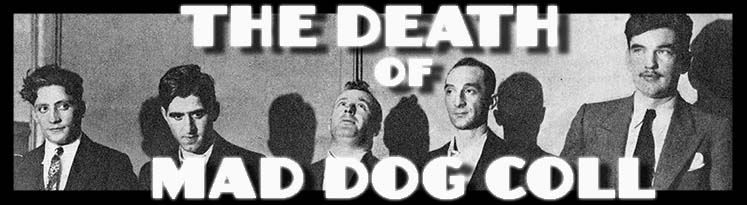
Accused of murdering a fifteen-year-old boy during a drive by shooting, Vincent “Mad Dog” Coll (far right) and his mob yucked it up with reporters during the trial.

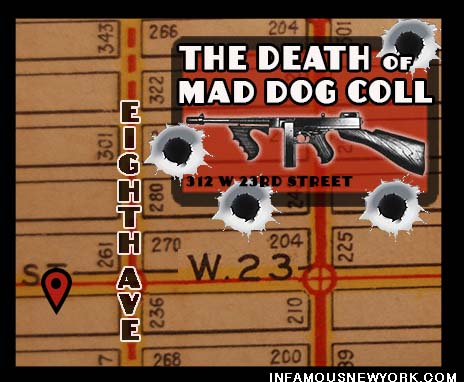
Location: 312 West 23rd Street

Status: Standing


By February of 1932, there wasn’t a soul in New York who didn’t want Vincent “Mad Dog” Coll on a slab in the morgue. The psychopathic egg had blow torched every bridge in gangland, and now Coll had to die


Powerful Enemies


During Prohibition’s heyday, Coll and his mob amassed a legendary list of underworld adversaries such as Lucky Luciano, Dutch Schultz and Owney Madden. First to join Coll’s list was the Beer Barron of the Bronx, Dutch Schultz, Coll’s former employer.


Paid to protect Dutch’s beer trucks, Coll, suffering from delusions of grandeur, decided to hijack the shipments instead. Schultz responded by putting the blast on Mad Dog’s kid brother and all out war erupted in the spring of 1931.


Lucky Luciano, Dutch Schultz, Owney Madden, Mad Dog Coll, Vincent Coll, Salvatore Maranzano, Mayor Jimmy Walker, Harlem Baby Massacre, Michael Vengalli, Joey Rao, Joseph Bonnano, Big Frenchy DeMange, Peter Coll , Petland Discounts, 312 West 23rd Street.

Now a Petland Discounts store, 312 West 23rd Street played host to Coll’s brutal machine gun murder.


Racketeer Without a Racket


Without a racket to fund his war against Dutch, the freelance gangster hatched the incredibly idiotic plan of kidnapping wealthy bootleggers like Big Frenchy DeMange, best friend of Hell’s Kitchen’s resident vice lord and owner of the Cotton Club, Owney Madden, whose nickname just happened to be “Killer.”


Coll made a clean sneak from the crime, shaking $50,000 out of Madden, but the Mad Dog wasn’t done by a long shot.


On July 28, Coll and his chopper squad loaded their tommy guns, jumped into a sedan and strafed the Helmar Social Club, headquarters of Schultz policy boss, Joey Rao. Machine gun gun bullets cut down five children, killing Michael Vengalli along with two Schultz heavies.


The Making of Mad Dog

In response to the brutal crime, New York Mayor Jimmy Walker dubbed Vincent Coll, “Mad Dog,” but Coll wasn’t finished alienating the powerful. In September of 1931, Salvatore Maranzano hired Coll to bump off Lucky Luciano.


However, Luciano’s men beat Coll to the punch, arriving a few minutes earlier to dispatch Maranzano. Coll walked away from the scene smiling and with yet another nemesis.


Vincent_-Mad_Dog-_Coll

Mad Dog Coll


Joseph Bonnano noted in his autobiography, A Man of Honor,


“Luciano told me he was forced to strike against Maranzano after learning that Maranzano had hired Vincent Coll to kill Luciano.”—Joseph Bonnano


Owney Madden Puts Mad Dog Coll on the Spot


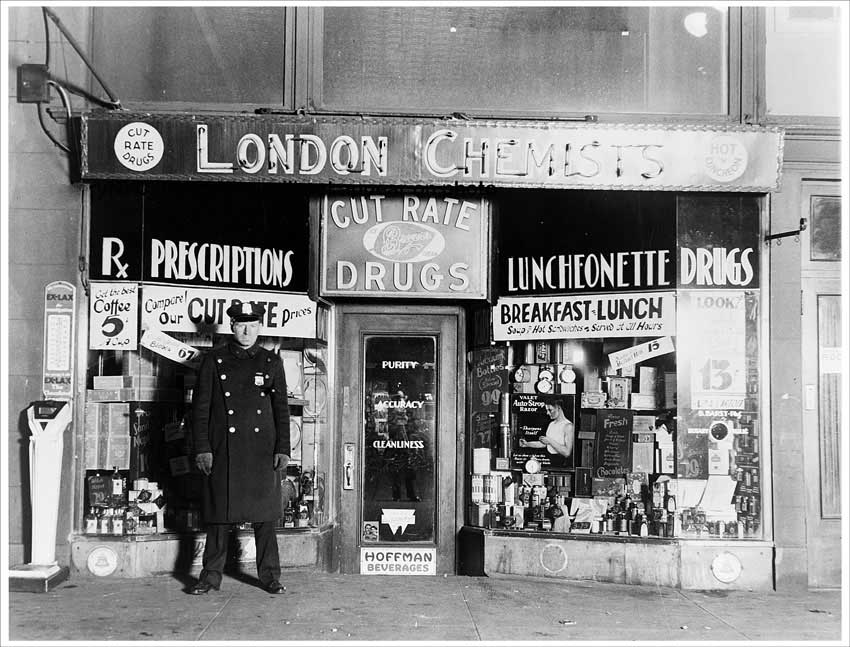
With the police hounding him and every mob in New York hunting him, Coll checked into the Cornish Arms Hotel on 23rd Street. On February 8, he walked into the London Chemist drugstore (now Pet Land Discounts) located at 312 West 23rd Street. Waiting for a phone call from Owney Madden to discuss a truce, Coll walked straight into an ambush.


Lucky Luciano, Dutch Schultz, Owney Madden, Mad Dog Coll, Vincent Coll, Salvatore Maranzano, Mayor Jimmy Walker, Harlem Baby Massacre, Michael Vengalli, Joey Rao, Joseph Bonnano, Big Frenchy DeMange, Peter Coll , Petland Discounts, 312 West 23rd Street.

Gangland put Mad Dog Coll on the spot at 312 West 23rd street at the London Chemists.

Phone Booth Massacre


When Coll entered a phone booth and spoke with Madden, the trap was sprung. Outside, a large limousine roared up to the curb, spilling out three gangsters.


Lucky Luciano, Dutch Schultz, Owney Madden, Mad Dog Coll, Vincent Coll, Salvatore Maranzano, Mayor Jimmy Walker, Harlem Baby Massacre, Michael Vengalli, Joey Rao, Joseph Bonnano, Big Frenchy DeMange, Peter Coll , Petland Discounts, 312 West 23rd Street.

The bullet riddled phone booth in which Mad Dog Coll was cut down. (Library of congress )


Two of the torpedoes covered the door, while a third drew a Thompson submachine gun from his trench coat, walked up to Coll’s phone booth and sprayed it with lead, killing the psychopathic, twenty three year old Coll instantly. According to the New York Evening Post:


“How many shots were fired is not known. Some witnesses said fifteen others said fifty. As the killer backed out of the store, the door of the booth opened slowly and Coll’s body pitched forward, three bullets in the head, three in the chest, one in the abdomen and eight and the arms and legs.”—New York Evening Post, 1932


The murder of Vincent Coll remains unsolved.


Lucky Luciano, Dutch Schultz, Owney Madden, Mad Dog Coll, Vincent Coll, Salvatore Maranzano, Mayor Jimmy Walker, Harlem Baby Massacre, Michael Vengalli, Joey Rao, Joseph Bonnano, Big Frenchy DeMange, Peter Coll , Petland Discounts, 312 West 23rd Street, london chemists

A New York City police officer standing in front of the drugstore where gangster Vincent Coll was murdered. (Photo Library of Congress.


Monk Eastman, William Delaney, Gangs of New York, Crime, Monk Eastman’s Murder, Owney Madden, Paul Kelly, Paolo Vaccarelli, 50 Eldridge Street, Witty Brothers.

Location: 50 Eldridge Street

Status: Standing


Out of all of the silk stocking wearing gangland dandies such as Owney Madden, Paul Kelly and Biff Ellison, Monk Eastman was a bit of an anomaly. He and his knuckle dragging mob terrorized Manhattan’s Lower East Side with street brawling shenanigans and epically bad fashion. According to Gangs of New York author, Herbert Asbury:


“[Eastman] seemed to always need a haircut… He accentuated his ferociousness… by affecting a derby hat several sizes too small…”


The Suit They Found Him Dead In

In addition to the ill fitting derby and bad haircut, Lower Eastsiders rarely sighted Eastman with a shirt on and without a shoulder-mounted pigeon, presumably crapping all over the place. However, the suit police detectives found Eastman dead in told a far different story. Inside of his jacket, a tag read, “E. Eastman, October 22, 1919—No 17,434—W.B.”


Known for wearing a derby hat several sizes too small, Monk was never a dapper mobster.

Known for wearing a derby hat several sizes too small, Monk was never a dapper mobster.


Monk’s Tailor

The tag belonged to the Witty Brothers, a fine clothing establishment, which catered to, “The Sort of gentlemen who recognizes the import of being well-dressed. “


Monk Eastman, William Delaney, Gangs of New York, Crime, Monk Eastman’s Murder, Owney Madden, Paul Kelly, Paolo Vaccarelli, 50 Eldridge Street, Witty Brothers.


According to the New York Times obituary of Spencer Witty, heir to the Witty clothing empire:


“Witty Brothers, fashioned and sold elegant men’s clothing… They used luxurious fabrics, cashmere, [and] Scottish tweeds…”—The New York Times (Click to read the article)


After Eastman’s murder in 1920, Henry Witty told the New York Tribune:


“Monk Eastman, the old time gang leader… We have made clothes for him for nineteen years. The last suit we made for him was delivered October 21, this year.” –The New York Tribune (click to read the story)


Perhaps the Monk was more dapper than originally thought?

Location: 1500 Broadway

Status: Demolished


They called themselves the Broadway mob. Members of the gang rubbed shoulders with high society, supplying the most exclusive speakeasies in New York with top-shelf, uncut booze. From their offices at the now demolished Hotel Claridge, located at 1500 Broadway, Meyer Lansky, Lucky Luciano, Bugsy Segal and Frank Costello would go from street gang to the masters of dry New York, making themselves multi-millionaires in the process.

Hotel Claridge, Lucky Luciano, Salvatore Luciana, Meyer Lansky, Frank Costello, 1500 Broadway, Bugsy Segal, Salvatore Maranzano, Joe Masseria, Joe The Boss Masseria, Giuseppe Masseria, Prohibition, Rum Running, Arnold Rothstein, The Brain of Broadway, Broadway, Stork Club, Silver Slipper, 21 Club, Scotch, Broadway Mob, Last Testament of Lucky Luciano, Rector’s, 1500 Broadway, 44th Street, prohibition, Speakeasies,


Located in the heart of Times Square, on the east corner of 44th and Broadway, the Claridge Hotel was built in 1910 and according to the 1917 Real United States and Canada Pocket Guide,


“ Claridge’s Hotel, formerly Rector’s…was the great theatrical and bohemian after-theater restaurant…”


By 1922, Orwell Maximillian Zipkes purchased the hotel, adding a two-story arcade with shops and offices that Lansky, Luciano, Segal and Costello would use to build their empire.


Like a league of extraordinary criminals, the gang’s success came from the Broadway Mob’s remarkably diverse hoodlum resumes. Costello was the talker, forging the alliances with Tammany Hall that allowed the mob to steal at will and carry concealed weapons, legally.


The psychopathic Bugsy Segal provided the muscle, killing and beating anyone who stood in their way. The bookworm, Lansky, existed as a behind the scenes strategist and human adding machine, making the gangsters wealthy beyond their wildest dreams. Its leader, the oldest member of the gang, was Lucky Luciano, a gangland heavy who oozed reptilian charm.


Hotel Claridge, Lucky Luciano, Salvatore Luciana, Meyer Lansky, Frank Costello, 1500 Broadway, Bugsy Segal, Salvatore Maranzano, Joe Masseria, Joe The Boss Masseria, Giuseppe Masseria, Prohibition, Rum Running, Arnold Rothstein, The Brain of Broadway, Broadway, Stork Club, Silver Slipper, 21 Club, Scotch, Broadway Mob, Last Testament of Lucky Luciano, Rector’s, 1500 Broadway, 44th Street, prohibition, Speakeasies,

In the 1920s, the Hotel Clairidge served as Lucky Luciano’s headquarters.

Lansky’s Law

Guided by Luciano’s charisma and Lansky’s financial acumen, the gang became rumrunners. They heisted furs and stuck-up banks to fund liquor shipments of the purist scotch in town, purchased from the Brain of Broadway, Arnold Rothstein.


The small time gangsters’ moxie captured A.R.’s attention, and an internship in crime ensued.


Meeting With The Mentor

Rothstein mentored the gang from his booth at Lindy’s, teaching them how to dress, how to speak and how to conduct themselves in high society. According to the Last Testament of Lucky Luciano, Luciano recalled:


He [Rothestein] taught me how to dress…how to use knives and forks…about holdin’ a door open for a girl, or helpin’ her sit down…”


In exchange for the mentoring, Lansky, Luciano and Costello served as Rothstein’s muscle, protecting his alcohol and narcotics shipments.


Purist Booze in Town

They travelled abroad as Rothstein’s purchasing agents, buying direct from distilleries in Scotland, keeping the Stork Club, The Silver Slipper, The 21 Club and the rest of Broadway’s high-end speakeasies swimming in hooch.


Pet Gangsters

By the height of prohibition, Pet gangsters were all the rage, and Luciano, Costello, Lansky and Siegel were the coolest mob in town. Suave, wealthy and deadly, they dated Ziegfeld Girls and slept with heiresses, earning them a privileged spot as the darlings of New York high society.


Luciano recalled:

 “Within a year, we was buyin’ influence all over Manhattan, from lower Broadway all the way up to Harlem.”


Mafia Talent Scouts

But the Broadway Mob had other, less reputable, admirers. A secret criminal society mostly unheard of in America, known as the Mafia, had their eyes on Luciano, the only Sicilian member of the gang.


Both the Masseria Crime Family and the Maranzano Crime Family knew that whomever controlled Luciano, controlled the Broadway Mob and their fat bankrolls and political connections. Masseria would eventually win Luciano’s loyalty. He was then upgraded to a floor of suites in the Hotel Pennsylvania, but for the rest of his life in American; however, Luciano maintained an unofficial office at the Hotel Claridge. The hotel was demolished in 1972.