
Posted in Uncategorized | Tagged Gangs of New York Tour, Infamous New York, Mafia Tour | Leave a Comment »
Sorry I haven’t posted any new stories in a while, everyone. On the day before New Year’s Eve, all of the people in my apartment building (including me) were served with papers to vacate the building in 30 days. The real estate developers (NYC’s new gangsters) are knocking down the building, and I am preparing to move on Friday. Once I get my computer out of a box, I hope to post some stories in the next week or two. In the meantime, follow me on Twitter or Facebook for links and external stories on the history of crime.
Share this:

Posted in Uncategorized | Leave a Comment »
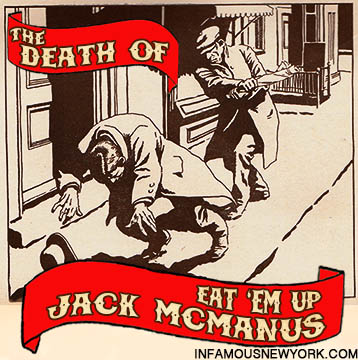
Without a whisper, a whimper or a groan, Thomas “Eat ‘Em Up Jack” McManus fell face down into his derby.
Location: NW Corner of Bleeker Street and Bowery
The blow came suddenly and silently. Without a whisper, a whimper or a groan, Thomas “Eat ‘Em Up Jack” McManus fell face down into his derby; his skull crushed like an egg. One hardest gorillas to ever drag his knuckles down the streets of New York, the legendary barroom bouncer could realistically hold claim to the title of: Toughest Man in New York. Now he was dead.
In his 1905 obituary, the New York Sun wrote,
For years back “Eat-‘Em-Up” has borne all but unchallenged the distinction of being about the toughest and most brutal of all the tough and brutal Bowery gangsters.
Toughest Man in New York
Born in Boston in 1862, McManus was seemingly destined for underworld stardom like his older brother, the infamous international safe cracker, Kid McManus. However, unlike his brother, Jack earned a living with his fists from the beginning, eventually following his knuckles to New York City as a champion lightweight prizefighter.
Unfortunately, the prize ring proved unsuitable for McManus’s constitution, and he quickly sunk into the employ of the underworld. Alfred Henry Lewis wrote in his 1912 book, the Apaches of New York,
…but a liking for mixed ale and a difficulty in getting to weight had long cured him [McManus] of that [boxing].

Eat Em Up Jack McManus was killed by Sardinia Frank on the north west Corner of Bleeker Street and Bowery.
Barroom Bouncing At McGurk’s Suicide Hall
Without boxing, Jack reverted to the only skill he knew, fisticuffs. He became a sheriff or bouncer, bringing law and order to the toughest Bowery dives and saloons in the city like the Tivoli and McGurk’s Suicide Hall. Whirling in like a Tasmanian devil with blackjacks, fists and hobnailed boots, Jack earned the nickname Eat Em Up for eating and digesting all comers. In time, McManus’s body became a patchwork quilt of wounds and welts. His front teeth were knocked out. A knife scar ran across his throat from ear to ear (back before one of his ears was chewed off).
That’s the way I serve ‘em.—Eat ‘Em Up Jack McManus, NY Sun 1903
Paul Kelly’s Five Points Gang
The mayhem artist caught the attention of Paul Kelly, and the mobster hired Eat ‘Em Up Jack as bouncer at Kelly’s Little Naples Café and New Brighton Hall, sowing the seeds of McManus’s death.
One night Chic Tricker, a member of the Jack Sirocco clique, drunkenly wandered into Kelly’s club and insulted the showgirls. McManus stepped in, throwing Tricker out on his ear. During the scuffle, a challenge was issued for gats on 3rd avenue. Later that night, Eat Em Up and Tricker traded pistol shots under the shadow of the 3rd Avenue “El.” Jack put two slugs in Tricker’s leg and walked away unscathed. But Tricker swore revenge.
The next day Kid Griffo and Eat ‘Em Up Walked down the Bowery. Just as they reached the corner of Bleeker Street, a burly hoodlum named Sardinia Frank stepped from the shadows clutching a gas pipe wrapped in newspaper, and as the New York Sun put it:
…a section of lead pipe was wrapped around the base of the skull to his bulldog chin, cracking the cranium all the way.
McManus died in Belleview Hospital calling out for his beloved wife Gertrude. He was 40
years old. Eat ‘Em Up Jack McManus’s death would kick off a gangland war between Kelly and Jack Sirocco which would close the New Brighton, leaving Kelly scampering uptown for a more “respectable” life.

Paul Kelly (right) and Eat Em Up Jack McManus (left) at the New Brighton.
Share this:

Posted in East Village, Gangs of New York, Lower East Side, Paul Kelly | Tagged Apaches of New York, Chick Tricker, Eat Em Up Jack McManus, Five Points Gang, Gangs of New York, Jack Sirocco, Kid Griffo, Kid McManus, McGurk’s Suicide Hall, Paul Kelly, Tivoli | 1 Comment »
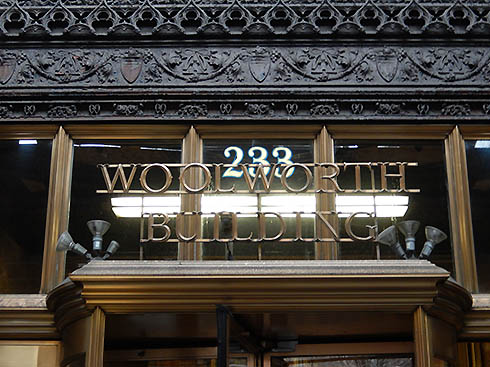
Location: 233 Broadway
Status: Landmarked
On the night of July 30, 1935, the voice of special prosecutor Thomas E. Dewey sailed out of Manhattan and poured out of tens of thousands of radios across the Five Boroughs. For a half hour, the Special Prosecutor sang an imperative plea, a call to arms for all New Yorkers to take back the city from the racketeers strangling it to death.
He explained that the foul stench of organized crime was suffocating New York, levying a “huge and unofficial sales tax” on everything from ice and coal to chicken and fish. He concluded his broadcast with an invitation for anyone who wanted help to visit him at his office.
If you have evidence of organized crime,” he concluded, “bring it to us…The rest is our job. We will do our best.”
A Cathedral of Crime Fighting
Personally hired by Governor Lehman and championed by Mayor Fiorello La Guardia, Dewey would wage a war against organized crime from a command post on the 14th floor of the Woolworth Building, transforming the Cathedral of Commerce into a cathedral of crime fighting.

Dewey’s Office was located on the 14th floor of the Woolworth Building where he would successfully prosecute Lucky Luciano.
Fort Dewey
Located far enough away from City Hall to thwart Tammany Hall spies, the 10,000 square foot fortress of an office had an untapable phone cable and tamper proof filing cabinets locked inside of a state-of-the-art, Holmes Alarm bank vault. Venetian blinds prevented telescope equipped gangsters from spying on informants, while plainclothes detectives patrolled the lobby 27/7.
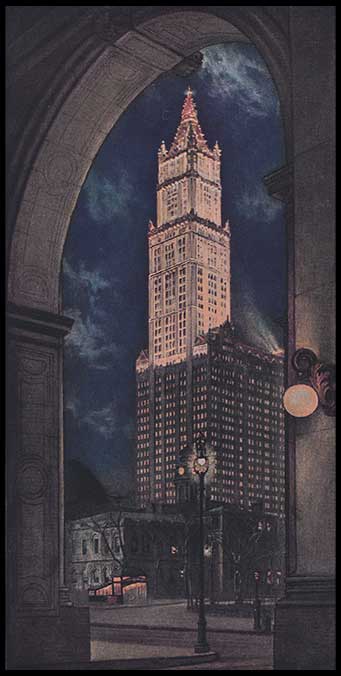
Dewey’s Office was located on the 14th floor of the Woolworth Building where he would successfully prosecute Lucky Luciano.
The Man Who Had Never Tasted Pastrami
With his castle built, Dewey, a farm boy from Owosso, Michigan, who had never heard of pastrami, set about building a multi-ethnic crime fighting army. He brought in Eunice Carter, one of the first African American female attorneys in America, and the future Irish Catholic D.A., Frank Hogan. Half of Dewey’s team was Jewish, seven held Phi Beta Kappas, and fourteen graduated from Harvard or Columbia.
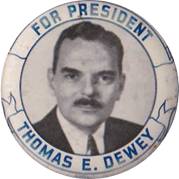
He staffed the office with twenty assistants, four process servers, ten investigators, four clerks, nineteen stenographers, a filing system wizard and sixty three NYPD officers hand picked by La Guardia’s police chief, Lewis Valentine. The underworld was screwed.
The office’s first target was Arthur Flegenheimer, a gangland heavy mostly known as Dutch Schultz. Soon, Dewey had his team shadowing Schultz, bugging his offices and phones, causing the gangster to take out a contract on Dewey’s life. Gangland intervened on behalf of the Special Prosecutor, and Schultz was gunned down in a Newark chophouse.
A Tsunami of Prostitutes
With the Dutchman dead, Dewey zeroed in on Lucky Luciano, New York’s overload of vice. After months of reconnaissance, Dewey’s team simultaneously raided 200 brothels around the city and herded hundreds of prostitutes up to the 14th floor of the Woolworth building to hear their stories, and boy did they sing.

Plainclothes detectives patrolled the Woolworth Building’s lobby 24/7 to ferret out gangster spies.
In the office’s crowning achievement, Lucky Luciano would be sentenced to 30 to 50 years for compulsory prostitution. Using the successes of his racket-busting prosecutions, Thomas E. Dewey would become Governor of New York and launch two unsuccessful presidential bids. But Dewey and Luciano weren’t done with each other by a long shot.
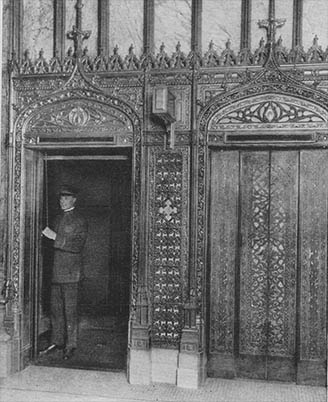
After a brilliant surprise raid on Lucky Luciano’s brothels, these elevator banks were used to shuttle hundreds of prostitutes up to the 14th floor.
Share this:

Posted in Broadway, Five Families, Lucky Luciano, NYPD | Tagged 233 Broadway, Arthur Flegenheimer, Dutch Schultz, Eunice Carter, Frank Hogan, Governor Lehman, Lewis Valentine, Lucky Luciano, Mayor Fiorello La Guardia, Prostitution, Special Prosecutor, Thomas E. Dewey, Woolworth Building | 4 Comments »
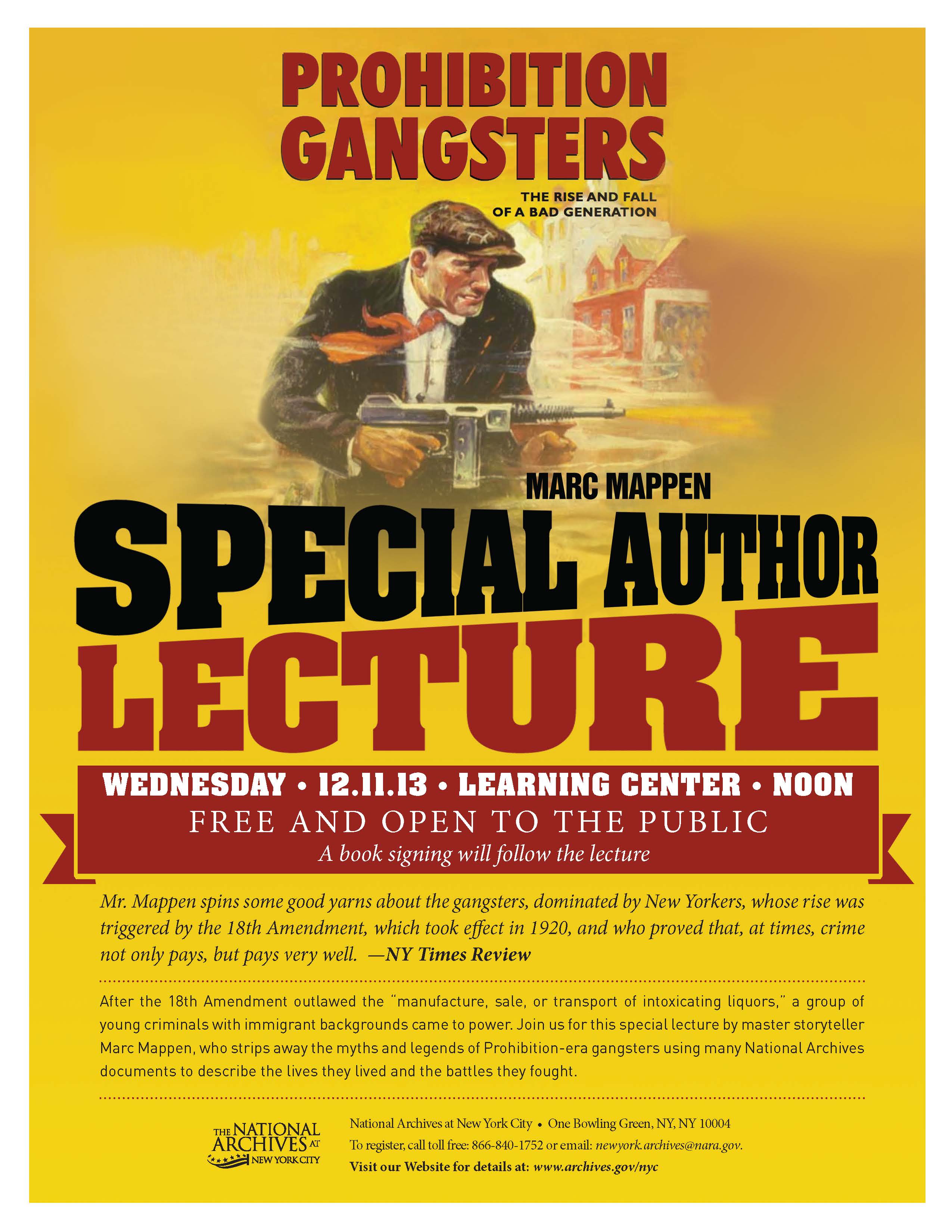
A rescheduled lecture will be held at the National Archives at New York City tomorrow, Wednesday December 11, at 12pm. “Prohibition Gangsters: The Rise and Fall of a Bad Generation” highlights many documents found within the holdings of the National Archives to describe the lives these gangsters lived and the battles they fought.
For more information about this event, see the National Archives website for this event:  http://www.archives.gov/nyc/public/2013-mappen-lecture.jpg
Share this:

Posted in Uncategorized | 2 Comments »

Joe Masseria’s Revenge
Location: 302 East 12th Street
Status: Standing
Smarting over the recent attempt on his life, which had left two bullet holes through his hat and another two holes through his coat, Joe Masseria plotted bloody revenge in epic Italian Renaissance fashion.
Toto D’Aquila’s Chief Assassin
The target of his wrath was Umberto Valenti, a seriously wily character who had blasted those bullet holes through Masseria’s hat and coat. According to the New York Times in 1915, Valenti was:
…alleged to have arranged more shootings than any other man in the city…

In the guise of peace treaty, Joe Masseria lured Umberto Valenti to John’s of 12th Street for his last meal.
A former Black Hand extortionist, it was rumored that Valenti had killed over 20 men, a number of whom had been Masseria’s closest advisors. The thirty four year old Valenti was the chief assassin of Salvatore “Toto” D’Aquila, the New York Mafia’s supreme ruler, a Mafioso who was locked in vicious mob war with Masseria and his chief strategist Giuseppe “the Clutch Hand” Morello.
However, Masseria’s seemingly supernatural bullet dodging powers had given the hard noised, but superstitious, Valenti second thoughts. Second thoughts that had him suing for peace and walking into an ambush in one of New York’s most storied Italian restaurants, John’s of 12th Street, on August 11, 1922, a restaurant that has been used as a set on Boardwalk Empire and the Sopranos.

1.Umberto Valenti emerges from John’s of 12th Street. Lucky Luciano and another assassin open fire. 2. Valenti draws a revolver and is hit in the chest with a bullet. He staggers to a waiting taxicab and dies. 3. The gunmen shoot two innocent bystanders before disappearing into a tenement.
Well Dressed Gunmen: Vito Genovese and Lucky Luciano
Whether or not Valenti sampled the chicken parmigiana before being croaked has been lost to the winds of history. However, some time around noon, Valenti and six laughing companions emerged from their luncheon. Walking eastward, smiles turned into frowns. Suddenly, Valenti spooked and bolted towards Second Avenue as two slick, well-dressed gunmen whipped out revolvers and fired. Gangland legend holds that one of the shooters was none other than Charley “Lucky” Luciano, Masseria’s newest protégé (the other shooter was probably Vito Genovese).

The candle in John’s of 12th Street was lit to celebrate the end of prohibition.
Pandemonium on 12th Street
As the shots flew, pandemonium broke loose on 12th Street. Whirling around, the feared assassin drew a revolver just as a bullet flew through his chest.
A teenage witness told the New York Times:
It was the coolest thing I ever saw. People were shrieking and running in all directions, and this fellow calmly fired shot after shot. He did not move until he had emptied his weapon. With blood spurting from his clothing, Valenti tried to raise up his pistol but his wounds prevented him from doing so. He made for a waiting taxicab, collapsing on the Northwest corner of 12th Street. (Click to read the original NY Times story)
Luciano’s Escape
Despite Valenti’s death, the friendly Luciano and his pals weren’t done yet. A crowd formed to block the gunmen’s escape so the mobsters opened fire, hitting a street sweeper and a little girl visiting from New Haven Connecticut. The shots dispersed the crowd, and the hitmen disappeared into a nearby tenement.
Should I Bring Pajamas?
Masseria was arrested for the murder. During his arrest, he supposedly grinned and asked the police:
… whether he would need a nightshirt remarking, that the last time he slept in the station house they forgot to give him a pillow or pajamas.
For a job well done, Joe Masseria elevated Luciano to a leadership position at his headquarters in the Hotel Pennsylvania. All murder charges were eventually dropped, and Masseria, on his way to becoming Joe the Boss, set his sights on Valenti’s overlord, Toto De Aquila, New York’s boss of bosses.
However, John’s of 12th had another infamous last meal lined up twenty years later. The victim would be Carlo Tresca.
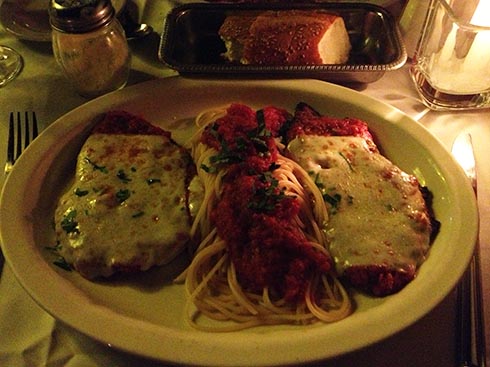
Whether or not Umberto Valenti sampled the chicken parmigiana before being croaked has been lost to the winds of history.
Share this:

Posted in East Village, Five Families, Genovese Crime Family, Joe The Boss Masseria, Lower East Side, Lucky Luciano, Prohibition, Vito Genovese | Tagged 302 East 12th Street, Charley Luciano, Clutching Hand Morello, Genovese Crime Family, Giuseppe “the Clutch Hand” Morello, Giuseppe Masseria, Joe Masseria, Joe the Boss Masseria, John’s of 12th Street, Lucky Luciano, Salvatore D’Aquila, Toto D’Aquila, Umberto Valenti, Vito Genovese | 2 Comments »
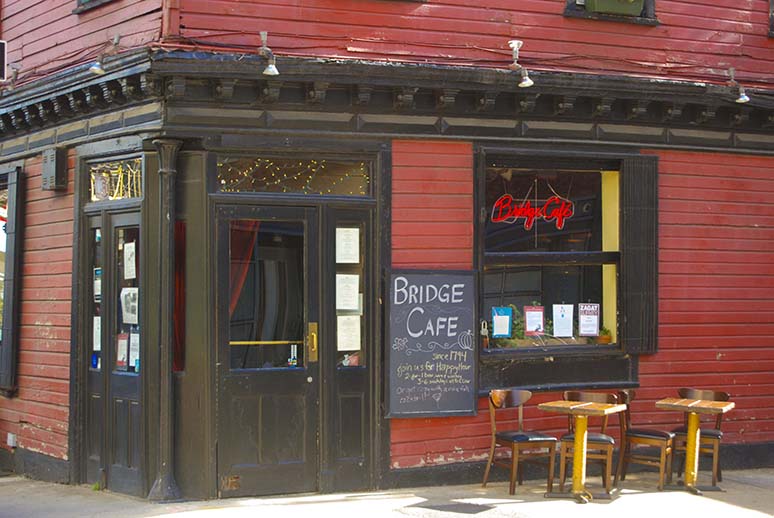
The Bride Café on Water Street was once known as the Hole-In-The-Wall Saloon, a vicious den of 19th century depravity.
Location: 279 Water Street
Status: Standing
From Schermerhorn Row to the Thomas Carpenter house, the South Street Seaport boasts not only New York’s oldest buildings, but also one of its oldest drinking establishments, a pirate bar located at 279 Water Street, but now thanks to Hurricane Sandy, the Bridge Café may have to be shuttered for good.
Booze and Blood by the Bucket
Constructed in 1794, this blood red, three story sagging wood framed structure on the corner of Dover and Water Street once housed the Hole-In-The-Wall-Saloon, a vicious den of 19th century depravity. Between the years of 1859 and 1881, the heyday of the East River pirates, the bar served up booze and blood by the bucket. In The American Metropolis, Reverend Parkhurst’s gangbusting Attorney Frank Moss called the bar:
…a bagnio [brothel] filled with river pirates and Water Street hags.
The Infamous Gallus Mag
In 1874 the Brooklyn Eagle had this to say about the bar:
It was there that thieves and junkmen would meet to ‘put up jobs;’ it was there that men were drugged and robbed and women beaten…it was there that young thieves became graduates in crime.
And it was there that folk legend Gallus Mag bludgeoned her way onto the scene. It is impossible to separate fact from fiction in the history of Mag, the noted six foot tall cockney bouncer, who kept a small sack filled with wet sand for knocking out sailors on her belt.
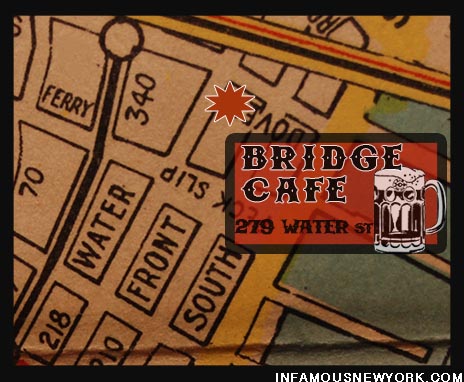
The Bridge Café is located 279 Water Street.
A Distinguished Thief
Gallus’s real name was Mag Perry, but Water Streeters called her Gallus on account of the very un-lady like suspenders (galluses) she wore. Gallus ran the Hole In The Wall with her husband Jack, the distinguished thief whose greatest claim to fame, other beating a fourteen year prison sentence, was when he swiped Josh Ward’s championship rowing belt.
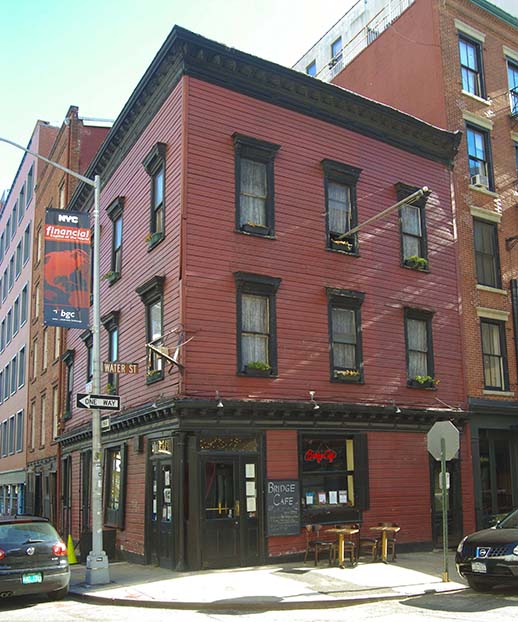
The Bridge Café is New York City’s last standing pirate bar.
Jack ran the front of the house, tending bar and robbing and drugging sailors, while Gallus worked clean up, biting off the ears and fingers of obstreperous bar flies. She kept those grisly trophies in a pickling jar on a shelf behind the bar that is still there today.
The Bridge Cafe
Around the 1880s the name of the bar was changed to the Bridge café, on account of the massive Brooklyn Bridge at the café’s doorstep. Before Hurricane Sandy the restaurant was akin to stepping back into the days of steam and sail, replete with an 1810 tin ceiling and an ancient mahogany bar.
Now the Bridge Café needs help. During hurricane Sandy the dining room was filled with over three feet of water, but there’s good news, according to this New York 1 article the café plans to reopen in two months. So when they reopen, why not drop in at the Bridge Café, grab a soft-shelled crab sandwich and tell them Gallus Mag sent ya?
Share this:

Posted in Corlear's Hook, Gangs of New York, River Pirates, South Street Seaport, Water Street Revival | Tagged 279 Water Street, Bridge Café, East River Pirates, Gallus Mag, Hole In The Wall Saloon, Hurricane Sandy, Water Street | 1 Comment »
Location: 265 East 10th Street
Status: Standing
He had a million names and known aliases but back when Charley Lucky Luciano was living in a tenement on East 10th Street, he was nothing more than Salvatore Lucania, an impoverished nine-year-old street urchin from the sulfur mining town, Lercara Friddi.
Fresh off the boat in April of 1906, the Luciana family led by the family’s ironhanded patriarch, Antonio, settled in a tenement at 265 East 10th in the slums of the Lower East Side.

Born Salvatore Luciana, Charley Lucky Luciano grew up in this tenement at 265 East 10th Street. His parents would live here until 1933.
P.S. 10: “Worst Time In My Whole Life”
Salvatore didn’t speak a word of English when he enrolled in P.S. 10, and he took an instant dislike to authority figures. He later told Martin Gosh and Richard Hammer, authors of The Last Testament of Lucky Luciano:
…wasn’t easy to go to an American school and not know a goddamn word of English…in my whole life, that was the worst time I ever experienced, the first couple of years at P.S. 10.
With a massive inferiority complex driving him forward, Luciano formed a multi-national pack of knickers-wearing hooligans and began pick-pocketing, plundering apple carts, and most importantly—cutting school. On these same streets, Luciano met Meyer Lansky while trying to shake Lansky down for his lunch money.

Lucky Luciano lived here at 265 East 10th Street
Salvatore Lucania: The Bad One
Beside himself with grief over his rotten son-of-a-bitch kid, whom neighbors called “The Bad One,” Antionio beat Salvatore for skipping school. Then he beat him for not having a job. When Antonio discovered that his son did in fact have a job; and it was crime, he beat him some more. The beatings continued and so did the stealing and the skipping of school—until truant officers caught up with Salvatore.
On June 25, 1911, The Board of Education sentenced the boy to the Truant School for a term of four months. Lucky Luciano later quipped:
…what a kid learns in that place is how to steal better…
Hats and Narcotics, A Delivery Service
On his release, Luciano swore to his pop that he would go straight. He got a job as a delivery boy at the Goodman Hat Company where he was struck by bight idea: while I’m out delivering hats, why not also deliver dope?
Days later, Luciano spotted the limousine of the local drug pusher parked in front 265 East 10th Street. The young mastermind began polishing the limo with a rag. When the pusher emerged from the building, he tossed Luciano a quarter. Hurling the quarter back, Luciano offered instead to deliver drugs, taking his first step into what would one day be a narcotics empire.

Luciano’s multi-national gang of knickers-wearing hooligans who terrorized East 10th Street must have looked something like this.
Salvatore Becomes Charley Lucano
The drug/hat delivery route didn’t last long. In 1916, the nineteen year old Luciano was caught with a vial of heroin stashed in a hat box. Eight months later, Lucky emerged from reform school with a brand new nickname, Charley, which of course his father detested.
The final straw came when Antonio found a stolen solid gold belt buckle in his son’s bedroom. Antonio was so enraged that he wrapped the buckle around his fist, punched Luciano and threw his son out of the apartment for good.
However, for the next sixteen years, even when he was living in the posh Waldorf Astoria and Barbizon Plaza hotels, whenever Charley Lucky Luciano was arrested, he gave 265 East 10th Street as his address, sending the coppers straight to his dear old dad’s doorstep.

Share this:

Posted in East Village, Lower East Side, Lucky Luciano, Narcotics | Tagged Barbizon Plaza, Charles Lucky Luciano, Charley Lucky, Drugs, Lucky Luciano, Meyer Lansky, Narcotics, Salvatore Luciana, Salvatore Luciana 265 East 10th Street | 8 Comments »

Kit Burns’ Rat Pit
Location: 273 Water Street
Status: Standing
If Michael Vick were alive in the 1860s he would have probably called Christopher “Kit” Keyburns’ Sporstman’s Hall home. A portly, jovial, pock-marked, sodden faced man, Kit operated a dog-fighting arena from this still-standing location. Now the third oldest building in Manhattan, this three story brick structure represented the heart of Water Street’s depravity. But today, the rat pit has gone the way of everything else in Manhattan—luxury housing.
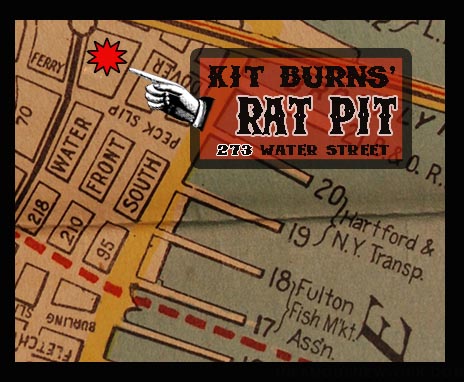
Kit Burns’ Sportsmen’s Hall was located at 273 Water Street.
A Start in Prizefighting
As a boy, Kit learned to work illegal prizefights under the tutelage of the bare knuckle boxing champ Yankee Sullivan. During one noted bout, Kit corned for fellow Water Streeter, Charley Lynch, during an eighty-six-round slugfest that ended in the death of Lynch’s opponent.
The Original Octagon
Prizefights made Kit’s reputation, but his real claim to fame was the Water Street Pit, a gas light illuminated octagon, eighteen inches high, sixteen feet long, and eight feet wide.
Wooden bleachers reached the ceiling and seated up to five hundred, and according to Oliver Dryer,
“Some of our city members of congress, state senators and assemblymen and municipal magnates, are Kit’s patrons.”–Oliver Dryer
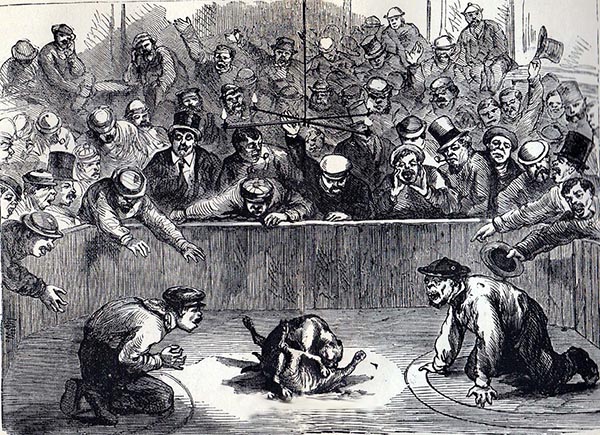
The humanitarians spend another night at Kit Burns Sportsmen’s Hall.
Rat baiting was one of the more popular games where sportsmen wagered on how many rats a terrier could slaughter. Jack, Kit’s prized 12 pound black and tan terrier, set a world record when he killed 100 rats in 5 minuets 40 seconds. After Jack died, Kit stuffed the champion pup and mounted him on the bar. Hung on walls and nailed to tables, Kit’s clientele could find the taxidermied champions of the past.
Kit’s Fighting Black Bear
Kit even owned a fighting black bear, which he pitted against challengers of any species. When not fighting, the bear had his own seat at the bar until he fell ill. Not wont to waste the skin, Kit skinned the fighter and turned him into a rug.
Bears and rats were all fine and good, but the dandies really came for the dogfights. The rules were simple. Trainers matched dogs of the same weight to fight in officiated battle with a cadre of surgeons at the ready. If an animal did not make weight, the humanitarians at the pit lashed their dog to a treadmill in the basement and whipped their fighter until it sweated off the excess pounds.

After weigh-ins, the coaches scrubbed their dogs with a scalding solution of water, soda, and castile soap. A taster then licked his dog from snout to paw to prevent the opposition from rubbing of their champion with numbing agents capable of weakening their opponent’s biting grip.
I tell you what, a greenhorn don’t stand any chance down here.— Christopher Kit Burns
Fights lasted hours, usually ending in death or a thrown towel. After the mêlée, the tasters licked the dogs again in case, as Kit put it:
…a fellow takes out a handkerchief and throws the stuff on the dog while he is fighting.
A standing bet of $1000 held that Burn’s dog, Belcher, could best any canine on the planet.
The ASPCA Closes In
When Kit wasn’t fighting dogs and rats, he battled the police and the ASPCA. In one instance, the NYPD crashed through a skylight and arrested scores of patrons for disorderly behavior. Kit eventually lost his grudge match with the ASPCA when the police arrested him for animal cruelty in November of 1870. The rat baiter caught diphtheria and died after beating the charges. He was 39 years old.

This fourth floor was added to the Kit Burns’ building in the 1900s.
Share this:

Posted in Gangs of New York, River Pirates, South Street Seaport, Water Street Revival | Tagged 273 Water Street, ASPCA, Belcher, Kit Burns, Oliver Dryer, Rat Pit, South Street Seaport, Water Street, Yankee Sullivan | 2 Comments »

Here at 82 Second Ave, bullets started to fly at Joe Masseria, blowing this plate glass window to smithereens.
Location: 82 and 80 Second Avenue.
Status: Standing
Rodded up and nervous as hell, the four chain-smoking mafia gunmen seated in a blue sedan on Second Avenue checked and re-checked their oiled .45 caliber Colt automatics while waiting for their mark, a portly gangster who would one day appear on Boardwalk Empire and be known as the Joe the Boss.
Part revenge and part business, the hit, they hoped, would end a mafia war that had paralyzed a stretch of pavement known as the Curbside Exchange, an open air liquor swap meet that had made Joe Masseria filthy stinking rich.
So rich in fact, that the New York Mafia’s current ruingleader, Salvatore “Toto” D’Aquila, wanted Masseria dead. To achieve his aims, D’Aquilia dispatched his chief assassin, Umberto “the Gin Millionaire” Valenti, to put Masseria on the spot on August 9, 1922.
A Barrage of Lead
Valenti’s four assassins waited diligently outside of Masseria’s apartment at 80 Second Avenue. At sometime around 2:00PM, Masseria exited his home with a smile on his face and a straw boater cocked on his head, unaware that two shooters had leaped out of a blue sedan with drawn .45 automatics.
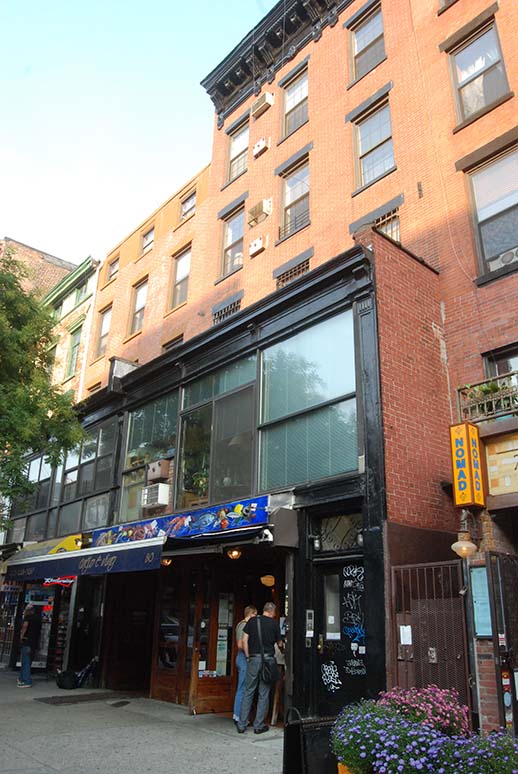
The cops later found Joe the Boss Masseria sitting in his apartment, here at 82 Second Avenue, dazed and deafened, with two bullets drilled through his straw hat and a slug blasted through his coat.
Just as Masseria noticed the gunmen, the slugs started flying. The fat gangster sprinted for cover in a shop at 82 Second Avenue but the hail of zipping bullets and shattering glass sent him racing home, but unfortunately for him, the gunmen had him at point blank range.
Masseria Dives for Cover
They fired, and the chubby gangster dodged to the left, a bullet creased his coat. The hoods fired again, and Masseria ducked, letting the bullet pass through his hat. Ducking and diving and jukeing and jumping, bullets whizzed past the Mafiosi.
An eye witness described the scene to the New York Times:
Just as he fired the man jumped to one side…Then the man fired again and this time the man being shot at ducked his head forward. Again the man fired and again his target ducked his head down. The third shot made a second hole in my window.
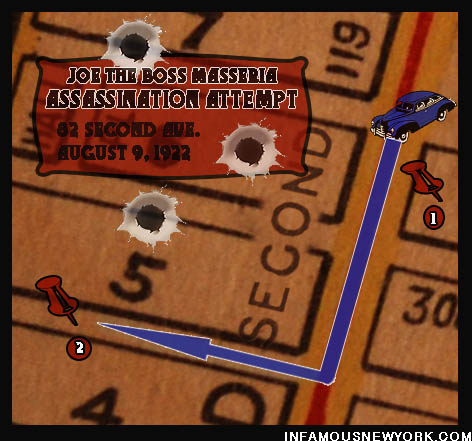
1) After completely botching the assassination on the bullet dodging Joe the Boss Masseria, the gunmen jumped into a waiting blue Hudson cruiser and roared off.
2) The getaway car plows though a pack of striking workers before escaping.
High Speed Pursuit
Completely botching the entire operation, the failed hitmen jumped onto the running boards of their blue Hudson Cruiser and roared down West 5th Street were they ran into even more trouble.
A meeting of striking workers had just ended, spilling a throng of angry socialists into the streets. Pissed off and tired of gangsters, factory owners and capitalist bastards in general, the striking workers erected a human blockade to stop the fleeing Hudson, but D’Aquilia’s gorillas were unfazed.
They attempted to plow their way through the human blockade; and when that failed, they opened fire, pumping bullets indiscriminately into the crowd, hitting six men and a pony.
According to The New York Call newspaper:
The Machine, after rushing through the panic stricken crowd…[was] pursued by 15 taxicabs, trucks, and private automobiles that had been commandeered by the police…
The chase went as far as 32nd Street where the police lost the gunmen, but the nearsighted shooters would eventually get theirs.

Joe the Boss Masseria in his later years.
The Man Who Dodged Bullets: Joe The Boss Masseria
Joe Masseria emerged from the failed rubout deafened and hatless, but his bullet dodging antics would make him an underworld legend. A week latter he would catch up with his would-be assassin, Umberto Valenti, and finish what The Gin Millionaire had started. Click to read the story: https://infamousnewyork.com/2013/11/23/joe-masserias-revenge-johns-of-12th-street-a-great-place-for-a-last-meal/
Share this:

Posted in East Village, Mafia, Prohibition | Tagged 80 Second Ave., 82 Second Avenue, Curbside Exchange, Giuseppe Masseria, Joe The Boss Maranzano, Joe the Boss Masseria, Salvatore “Toto” D’Aquila, Umberto Valenti | 7 Comments »
Categories
- Al Capone
- Albert Anastasia
- Arnold Rothstein
- Broadway
- Brooklyn
- Casinos
- Castellammarese War
- Chelsea
- Chinatown
- Corlear's Hook
- Dutch Schultz
- East Village
- Fiorello La Guardia
- Five Families
- Five Points
- Frank Costello
- Fulton Fish Market
- Gambino Crime Family
- Gangs of New York
- Genovese Crime Family
- Greenwich Village
- Humpty Jackson
- Irish Mob
- Italian Squad
- Jewish Mob
- Joe The Boss Masseria
- Johnny Torrio
- Joseph Petrosino
- Lifestyles of the Rich and Infamous
- Little Italy
- Lower East Side
- Lucchese Crime Family
- Lucky Luciano
- Mafia
- Mafia Commision
- Mob Speak Institue: Mouthpiece Marconi Puppet Gangster
- Monk Eastman
- Narcotics
- New Jersey
- Nightlife
- NYC Jails & Prisons
- NYPD
- Owney Madden
- Paul Kelly
- Prohibition
- River Pirates
- South Street Seaport
- Speakeasy
- Tammany Hall
- Tenderloin / Satan’s Circus
- Tong Wars
- Uncategorized
- Vincent “The Chin” Gigante
- Vito Genovese
- Water Street Revival
Infamous New York
Follow me on Twitter
My Tweets- Follow Infamous New York on WordPress.com
Blog Stats
- 832,049 hits
Gangland is lonesome: Like us on Facebook
 Infamous New York